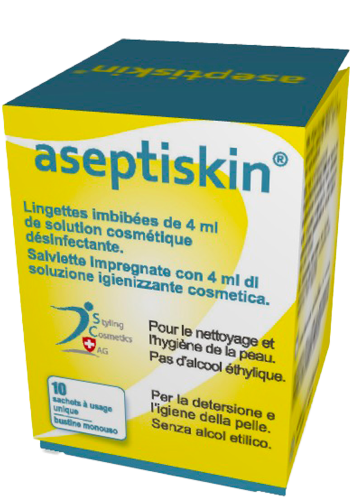
Aseptiskin
Prepare the treatment area under strict aseptic conditions, preserving all anatomical and procedural markings to ensure accuracy and reproducibility of the protocol.

Aseptiskin is not positioned as a simple cleanser. It is an alcohol-free skin preparation solution developed to support procedural accuracy before professional aesthetic interventions. Its role is to prepare the skin surface without the excessive dryness, uncontrolled evaporation, or unnecessary interference that may be observed with harsher degreasing approaches.
Aseptiskin belongs to the preparatory phase of superficial professional protocols. Its value lies in optimizing the skin surface before peeling or related clinical procedures, while preserving a more controlled and readable cutaneous environment.
Its primary function is to cleanse and prepare the skin before intervention without relying on aggressive alcohol-based stripping. This contributes to better procedural consistency, better tolerance, and improved compatibility with precision-oriented protocols.
Aseptiskin supports a more rational clinical approach: prepare first, intervene second. By avoiding unnecessary disruption of the skin surface, it helps maintain better protocol coherence before the use of chemical peels, functional combinations, or other medically supervised applications.
Functional positioning summary: Aseptiskin should be understood as a pre-procedural clinical preparation tool, not as a routine cosmetic cleanser. Its relevance is directly linked to protocol control, skin respect, and treatment consistency.
Aseptiskin is indicated in all situations requiring controlled skin preparation prior to aesthetic or dermatological procedures. Its alcohol-free formulation makes it particularly suitable when precision, tolerance, and protocol consistency are required.
These technical parameters define the practical role of Aseptiskin before professional procedures. The objective is not aggressive degreasing, but controlled surface preparation with better respect for skin balance, protocol readability, and procedural consistency.
Aseptiskin is intended for pre-procedural skin preparation in professional aesthetic and medical environments where a cleaner, more stable, and more readable skin surface is required before action.
The alcohol-free profile is a central technical parameter. It helps avoid the excessive dryness, abrupt evaporation, and surface instability that may interfere with delicate protocol execution.
Aseptiskin is suitable for integration into multi-step professional protocols in which skin preparation must remain coherent with the biological and technical logic of the treatment that follows.
One important parameter is preservation of a clearer procedural field. Better surface readability may improve clinical observation, marking stability, and adaptation of the subsequent step to the real skin condition.
Technical summary: Aseptiskin is defined by its role as a professional alcohol-free preparation solution used to support skin tolerance, protocol compatibility, and procedural control before aesthetic or medically supervised intervention.
The formulation of Aseptiskin is based on a controlled cleansing system combining surface-active agents and mild antimicrobial support. The objective is to prepare the skin without aggressive disruption, ensuring compatibility with precision-based clinical protocols.
A quaternary ammonium compound contributing to surface cleansing and controlled microbial environment. Supports hygienic preparation without the aggressive volatility of alcohol-based systems.
Provides mild antimicrobial support while maintaining formulation stability. Contributes to a balanced surface environment compatible with sensitive or reactive skin conditions.
Complements the preservative system, ensuring product integrity and contributing to a controlled hygienic environment without excessive disruption of the skin surface.
Supports removal of impurities and excess lipids while maintaining a softer cleansing profile. This allows preparation of the skin without compromising its functional balance before treatment.
While primarily developed for skin preparation, Aseptiskin may also be used on selected high-contact surfaces where a controlled, non-aggressive cleansing approach is preferred.
This extended use reflects the formulation philosophy of Aseptiskin: cleaning without unnecessary disruption, in contrast to harsh alcohol-based systems.
In many aesthetic practices, alcohol-based cleansing is still considered a standard preparatory step. However, this approach is often driven by habit rather than by a controlled understanding of skin behavior during clinical procedures.
Alcohol does not simply clean — it alters the skin environment. Its rapid evaporation, dehydrating effect, and potential to disturb the superficial balance may introduce variability in protocol execution, especially in procedures requiring precision and reproducibility.
Leads to uncontrolled changes in surface condition, reducing predictability before treatment.
Alters the skin’s immediate response and may influence the behavior of subsequent active agents.
Creates a less controlled environment, particularly problematic in multi-step or layered protocols.
Introduces inconsistency between sessions and patients, reducing reproducibility of outcomes.
Aseptiskin follows a different philosophy: preparation should support the procedure, not interfere with it. By avoiding aggressive alcohol-based disruption, it helps maintain a more stable and controllable starting point.
A clear understanding of Aseptiskin’s role is essential. It is designed as a controlled preparation solution, not as an aggressive or disruptive system.
In precision-based aesthetic procedures, the quality of preparation directly influences the outcome. Aseptiskin is not an optional step — it is a control tool that defines the conditions under which the treatment will perform.
Unlike alcohol-based preparation, Aseptiskin maintains skin markings and mapping, allowing accurate guidance during injections or targeted treatments.
By avoiding abrupt surface disruption, it creates a more stable starting point, improving reproducibility between sessions and patients.
Maintains a cleaner and more controlled visual field, allowing better assessment of the skin before and during the procedure.
Avoids excessive dehydration and unnecessary stress on the skin, supporting a more rational and biologically coherent preparation phase.
Particularly valuable in techniques requiring exact placement, such as Endopeel or layered peeling protocols.
Preparation is no longer a routine step — it becomes a controllable parameter influencing the quality and predictability of the entire procedure.
Alcohol-based solutions may react with peeling formulations through esterification. Clinically, this can lead to extensive visible staining that may persist for approximately one month and cannot be treated during that period.
Tonics, make-up removers, cleansing milks, and similar cosmetic products are inappropriate in a medical context. They may sustain or aggravate acne or inflammatory lesions, which must never be stimulated prior to a peeling procedure.
A single inappropriate substitution is sufficient to compromise the reproducibility and predictability of the entire peeling protocol.
Aseptiskin provides controlled and reliable skin preparation prior to aesthetic and dermatologic procedures, ensuring optimal surface conditions without altering markings or procedural precision.
Aseptiskin is not a standalone product logic. It establishes controlled preparation conditions, but the full clinical performance emerges only when it is integrated into a coherent peeling protocol. In other words, preparation creates control, and protocol coherence creates results.
These combinations extend the preparatory role of Aseptiskin into active procedural control, protocol safety, and better reproducibility.
Used after appropriate aseptic preparation, Prepeel helps optimize the receptive condition of the skin before the active peeling phase. It belongs to the logic of controlled protocol entry rather than random application.
In protocols involving TCA, this product helps control frosting and limit demarcation phenomena. Its behavior becomes more predictable when the skin has first been prepared in a clean, stable, non-disrupted manner.
When used as part of advanced protocol architecture, Lipoic Acid contributes to depth modulation and strategic procedural control. The quality of preparation directly influences the coherence of this level of intervention.
These products do not replace Aseptiskin. They amplify, refine, or prolong the benefits of a well-controlled preparation step.
Supports controlled mechanical refinement of the skin surface in selected protocols. When preceded by coherent aseptic preparation, it may help improve surface regularity and subsequent protocol homogeneity.
Supports epidermal comfort and barrier recovery following aseptic skin preparation, while helping maintain epidermal balance and hydration between procedures.
Provides metabolic support while contributing to functional photoprotection, extending the logic of controlled skin protection beyond the procedure itself.
Protocol intelligence: replacing Aseptiskin with an unsuitable cosmetic or alcohol-based alternative may compromise the behavior of every subsequent step. By contrast, integrating Aseptiskin with the right complementary products protects markings, chemistry, readability, and protocol integrity from the very first phase.
Aseptiskin is designed for professional environments where procedural precision, reproducibility, and controlled skin preparation are required prior to aesthetic or dermatologic interventions.
Protocol position: Aseptiskin is used at the initial stage of the procedure, where it defines the conditions under which all subsequent actions will take place. Preparation determines control, and control determines outcome.
Aseptiskin is not a routine cosmetic cleanser. It is a professional preparation solution designed to preserve procedural markings, protect protocol integrity, and establish the clean, stable conditions required before peeling or precision-based intervention.
Clinical decision point: when preparation is inaccurate, every subsequent step becomes less predictable. Choosing Aseptiskin means starting the procedure under controlled and reproducible conditions.


Utilizziamo cookie e tecnologie simili per migliorare la tua esperienza di navigazione nel nostro sito web.