The Old Model
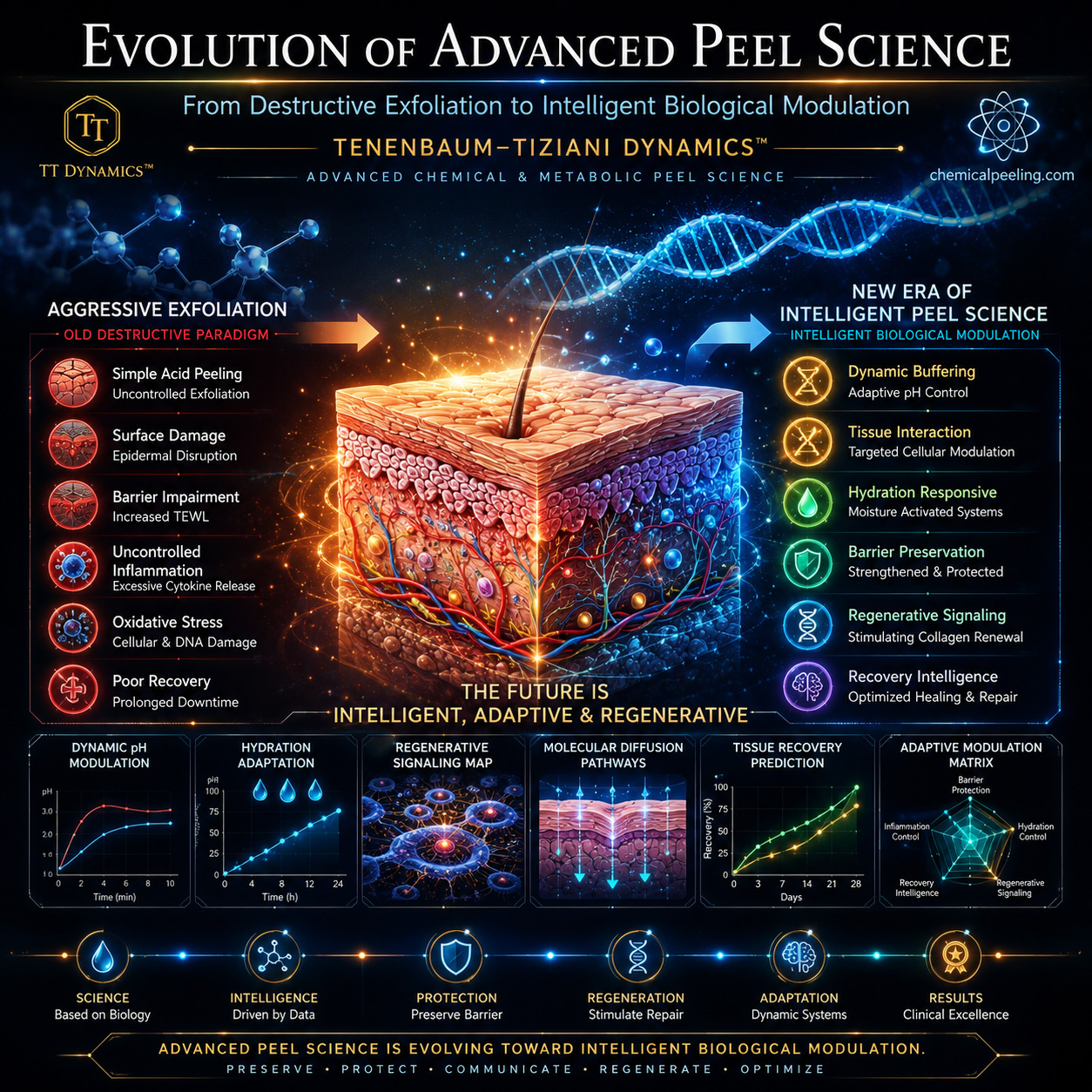
Peels were commonly understood through a relatively simple hierarchy of chemical strength and visible injury.
Chemical peeling is not an outdated technique. What has changed is the way we understand skin response, biological mechanisms and treatment strategy.
Chemical peeling is not an outdated technique. What has become outdated is the way it was traditionally taught.
Peels were commonly understood through a relatively simple hierarchy of chemical strength and visible injury.
Modern peeling requires understanding what the skin is being asked to do — and how it responds before, during and after treatment.
A peel should no longer be understood only by how much skin it removes, but by what biological response it is designed to produce.
The ingredient alone does not define the clinical behavior of a peel.
Treatment planning begins with the biological structure or process to influence.
Clinical observation becomes more important than following time alone.
Greater visible injury does not automatically mean a better biological result.
Modern peeling belongs within a planned sequence of correction, recovery and maintenance.
Learning peeling today is therefore not about memorizing a list of acids and concentrations.
It is about learning to read the skin.Follow the evolution from traditional peeling concepts toward biological reasoning, clinical interpretation and longitudinal treatment strategy.
Lasers, injectables and energy-based technologies have transformed aesthetic medicine. They have not eliminated the biological processes that chemical peeling can address.
The question is no longer whether peeling is old or new. The relevant question is: what can this modality do biologically?
Different mechanism.
Different clinical possibilities.
Modern peeling can interact with several clinically relevant dimensions of epidermal function and skin behavior.
Influence abnormal accumulation and organization within the outer epidermal layers.
Address pigmentary irregularity through strategies adapted to melanogenesis, epidermal turnover and risk.
Improve the clinical appearance of irregular surface texture through controlled tissue interaction.
Modulate epidermal turnover and the transition from existing surface architecture to renewed tissue.
Treatment strategy must consider inflammation as part of the biological terrain rather than as an isolated sign.
Barrier condition, water retention and recovery influence tolerance, response and treatment sequencing.
Modern aesthetic medicine does not require one technology to replace every other one. Clinical judgment begins by understanding what each modality is designed to influence.
Peeling remains relevant because skin biology remains relevant.
The modern practitioner learns not simply how to apply an acid, but when a chemical-biological approach is the appropriate tool.A chemical name does not tell you what a patient’s skin needs. Before selecting a peel, the practitioner must first understand the biological terrain being treated.
These processes are interconnected. They should not be interpreted as six isolated diagnoses, but as a structured way to examine the skin before deciding how to intervene.
Begin by asking whether the epidermal barrier is stable enough for the intended intervention.
Hydration status and water-retention capacity influence surface quality, tolerance and recovery behavior.
Observe how the outer epidermis is forming, accumulating and shedding before attempting to modify it.
Pigmentation must be interpreted together with phototype, melanogenic activity and the risk of PIH.
Active or residual inflammation can change both treatment tolerance and the pigmentation response.
Treatment planning must anticipate how the skin will recover, reorganize and regain stability afterward.
A disturbance in one dimension can influence the others. Treatment therefore requires interpretation of the whole biological context, not simply selection of a stronger or weaker acid.
Before learning how to apply a peel, learn how to interpret the skin that will receive it.
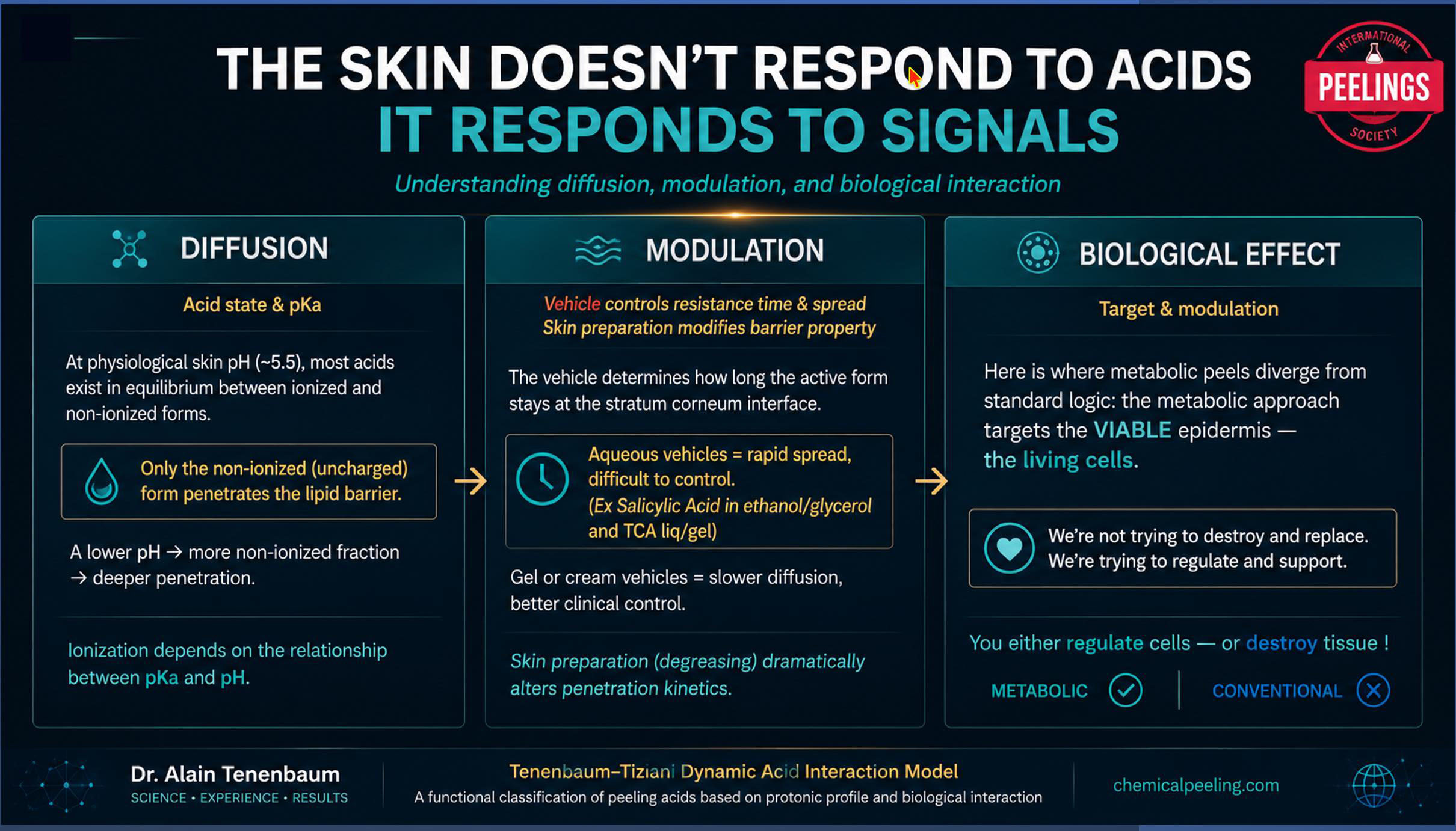
Knowing the active ingredient is not the same as understanding how a peel will behave on the skin.
The clinical response emerges from the interaction between chemistry, formulation, application and biological terrain.
Two preparations containing the same named acid may not behave identically. Their clinical effect depends on much more than the ingredient printed on the label.
A percentage is a chemical descriptor. It is not a complete treatment strategy.
Clinical response results from several variables acting together. Learning them prevents the practitioner from reducing peeling to an acid name and a concentration.
The chemical agent establishes an important part of the potential biological interaction.
Concentration matters, but it cannot predict the complete clinical response by itself.
Acidity contributes to chemical behavior and must be interpreted together with the formulation.
The delivery environment influences contact, distribution and interaction with the skin.
The complete formula matters more clinically than the isolated active ingredient alone.
Quantity, distribution, layering and technique can modify how the formulation interacts with tissue.
Facial, body and intimate skin cannot automatically be approached as biologically equivalent surfaces.
Barrier status, inflammation, pigmentation and previous treatments modify the biological terrain.
Exposure must be interpreted in relation to the formulation and the tissue response being observed.
What happened before the session may influence penetration, tolerance and subsequent recovery.
The acid name and percentage provide information, but they do not describe the entire clinical system.
The practitioner integrates formulation, application, anatomical region and the condition of the skin.
Learning acids is useful. Learning how formulations interact with real skin is essential.
If formulation cannot predict everything, how do we know what the skin is actually doing?
Observe the clinical endpoint →Application technique matters. Timing matters. But neither can replace direct observation of how the tissue is responding.
A clinical endpoint is not one universal sign. It is the treatment-specific response that tells the practitioner whether the intended interaction is developing as expected.
Time is useful for standardization and safety, but elapsed minutes alone do not describe what has actually happened in the tissue.
The practitioner combines time with visible response, patient tolerance and treatment-specific endpoints to guide the next decision.
The endpoint belongs to the tissue — not to the clock.
Observe first. Interpret second. Decide third.Not every sign has the same meaning in every formulation. The objective is to recognize patterns of response and interpret them within the treatment being performed.
Observe its onset, distribution and progression rather than recording only its presence or absence.
In treatments where frosting is meaningful, its appearance must be interpreted according to the chemistry and intended endpoint.
Changes in surface appearance and tactile quality may provide additional information about the evolving tissue interaction.
Sensation and tolerance belong to the clinical picture and should be interpreted together with visible signs.
Some treatment effects are progressive and cannot be judged solely by an immediate dramatic surface sign.
Unexpected or excessive responses must be recognized as reasons to reassess the treatment rather than reasons to continue toward a predetermined time.
The same visible sign may carry different significance depending on the formulation, anatomical region, biological target and stage of treatment.
This oversimplifies treatment response and risks turning one visible phenomenon into a universal measure of effectiveness.
Clinical interpretation depends on the agent, formulation, intended endpoint, tissue and treatment strategy.
Protocols provide structure. Endpoints provide feedback.
The practitioner must know both the expected response and the signs that require reassessment.“ Do not treat the timer.
Treat the tissue.
Can the same endpoint and the same treatment strategy be applied to every skin phototype?
No — the biological terrain changes the strategy →Two patients may present with the same clinical indication without requiring the same peeling strategy.
Phototype, pigmentary behavior, barrier condition and inflammatory tendency influence how treatment should be prepared, delivered, observed and followed.
Same indication ≠ same protocol.
The diagnosis identifies the problem. The biological terrain helps determine how to treat it.Phototype is clinically useful, but it should not be treated as the only variable. Pigmentary history, barrier status, inflammation and previous responses also matter.
Provides useful information about cutaneous response and the context in which pigmentation risk is assessed.
Previous hyperpigmentation and melanogenic reactivity may be more informative than phototype alone.
A compromised or unstable barrier can change tolerance, recovery and the appropriate treatment sequence.
Inflammation may influence both immediate tolerance and subsequent pigmentary behavior.
Adaptation is not limited to choosing a lower or higher concentration. It extends from preparation to long-term maintenance.
Prepare the skin according to its condition, pigmentation risk and intended treatment.
Match treatment intensity to the clinical objective and the biological terrain.
Interpret visible and sensory responses within the context of the individual patient.
Allow sufficient time between interventions for recovery and reassessment.
Support barrier recovery and observe for unexpected inflammatory or pigmentary change.
Preserve improvement while controlling the biological drivers of recurrence.
Fitzpatrick phototype is one component of clinical assessment. It does not replace direct evaluation of the patient's pigmentary behavior, inflammation, barrier condition, treatment history and current skin status.
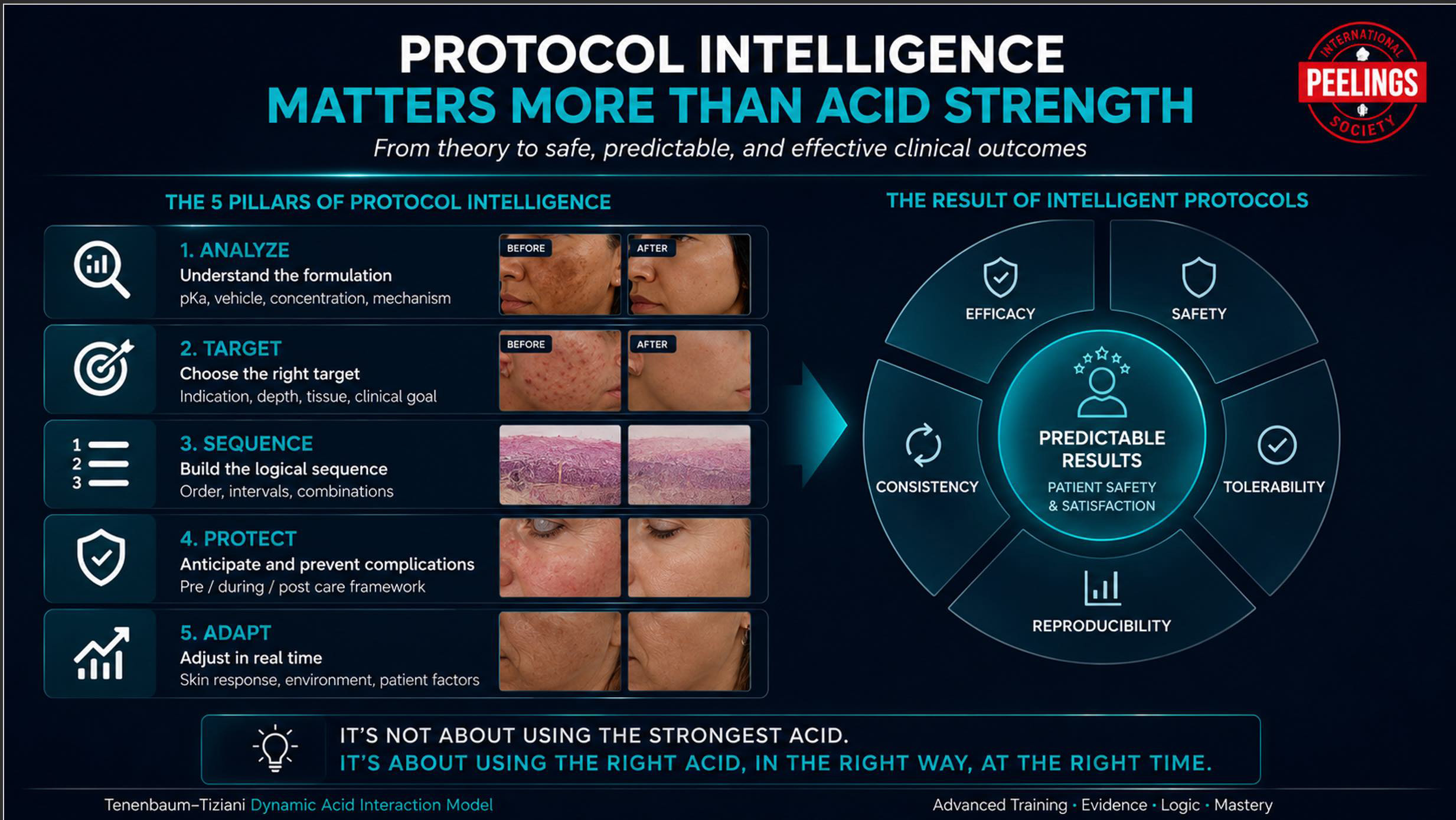
A protocol is not truly clinical until it can be adapted to the patient.
Modern peeling therefore requires both standardized knowledge and individualized judgment.“ Same indication.
Different strategy.
Treatment planning does not end when the peeling solution leaves the skin.
The treatment continues through recovery and maintenance →A peeling session is an intervention. A treatment program is a strategy.
Modern peeling is not organized only around what happens during application. It follows biological objectives across time.
Application is only one point in a longer biological sequence.
Clinical objectives are organized across correction, stabilization and maintenance.
Do not organize treatment around sessions alone.
Organize it around biological objectives over time.Each phase has a different clinical purpose. The objective is not simply to repeat the same intervention, but to move the skin toward a more stable result.
Address the dominant clinical mechanism.
The initial objective is to act on the biological process responsible for the clinical indication.
Consolidate the response and restore stability.
The strategy shifts from active correction toward recovery, biological balance and control of recurrence drivers.
Preserve the biological result over time.
Maintenance aims to preserve improvement while limiting the biological conditions that favor recurrence.
The clinical question is not only what to do today. It is also what biological objective should come next.
Modern peeling is not organized around isolated sessions.
It is organized around biological objectives that change as treatment progresses.“ Correction.
Stabilization.
Maintenance.
A longitudinal treatment strategy also requires knowing when treatment should not begin, when it should be modified, and when it should stop.
Safety is not a warning at the end — it is a clinical skill →Once peeling is understood through biological targets, tissue response and treatment sequences, depth alone can no longer organize the discipline.
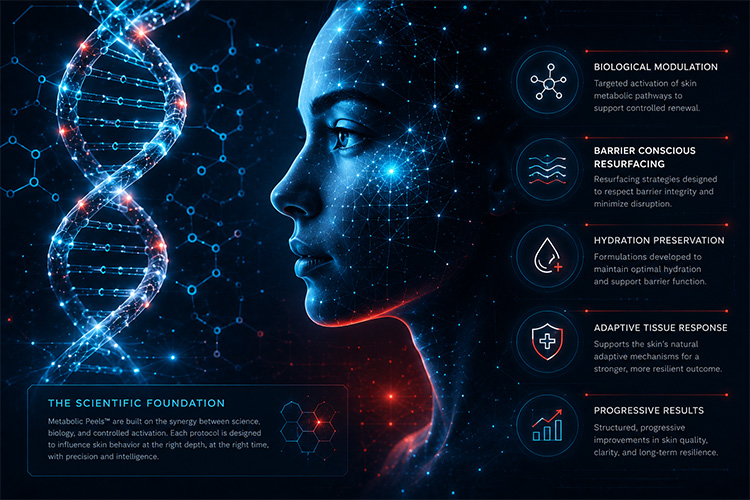
The Tenenbaum–Tiziani metabolic model shifts the educational focus from producing injury toward understanding how treatment can modulate, correct, stabilize and maintain biological response.
In this model, treatment is primarily interpreted through chemical strength, tissue injury, visible peeling and subsequent regeneration.
The practitioner learns to define the biological target, interpret tissue response and organize treatment over time.
The objective is not simply to make skin peel.
The objective is to produce the appropriate biological response for the clinical problem being treated.
A fixed recipe teaches what to apply. A biological model teaches why, when and how the strategy should change.
Technical application remains important, but it becomes one component of a broader clinical reasoning process.
Which acid?
How strong?
How deep?
How long?
One session
Repeat
The next decision is informed by the biological response to the previous intervention.
Metabolic peeling does not make chemistry, concentration, pH, formulation or application technique irrelevant. It places them inside a larger biological strategy.
Metabolic peeling transforms peeling education from the memorization of procedures into the interpretation of biological strategy.
The practitioner learns not only how to perform a peel, but how to reason through an evolving treatment program.“ Modulate.
Correct.
Stabilize.
Maintain.
If modern peeling requires biological reasoning rather than procedural memorization, what exactly should a practitioner learn?
Build the modern peeling curriculum →Modern peeling education should not begin with a list of acids and percentages.
It should build clinical reasoning in a logical sequence: from understanding the skin to designing, observing and maintaining a treatment strategy.
Technique can be memorized.
Clinical judgment must be learned.Each competency prepares the practitioner for the next. The objective is not to accumulate isolated facts, but to connect biological knowledge with clinical decisions.
Understand the biological terrain before attempting to modify it.
Identify the biological process that should become the target of treatment.
Determine whether the indication, biological terrain and treatment context are appropriate for intervention.
Understand why the active ingredient alone does not define the behavior of the peel.
Translate the treatment strategy into controlled, reproducible clinical technique.
Observe the tissue and interpret whether the evolving response corresponds to the intended treatment.
Follow how the skin restores stability after intervention and identify whether recovery is progressing as expected.
Preserve the biological result and determine how the strategy should evolve after correction and stabilization.
Biology, mechanisms and formulation.
Patient, tissue and clinical response.
Connect observations with biological meaning.
Choose what should happen next.
Clinical education should also teach you why you are doing it, what to observe, and when the plan should change.
Learning peeling today means learning a system of clinical reasoning.
The chemistry matters. The technique matters. But their clinical value depends on the practitioner who can interpret the skin and adapt the strategy.“ Technique can be memorized.
Clinical judgment must be learned.
These competencies can now be explored through the clinical, scientific and protocol resources of ChemicalPeeling.com.
Move from the learning model to the learning pathway →You now know what a modern peeling practitioner should learn. Now explore where to learn it.
ChemicalPeeling.com is organized as a connected educational system — from clinical understanding and treatment strategy to formulation, science and documentation.
Understand indications, biological mechanisms and the clinical contexts in which peeling strategies are considered.
Translate biological reasoning into structured treatment strategies, clinical sequences and indication-specific pathways.
Understand formulations, functional characteristics and the principles that guide product selection within a clinical strategy.
Explore the biological and scientific foundations that support modern understanding of skin response, mechanisms and metabolic peeling.
Access publications, educational material and supporting documentation for deeper study and clinical reference.
Clinical topics, protocols, products, science and documentation should not be studied as isolated libraries. Together, they form a connected framework for understanding modern peeling.
ChemicalPeeling.com is designed to help move from isolated information toward connected clinical understanding.
Follow the pathway that matches your question, then connect it with the other parts of the system.“ Understand.
Plan.
Select.
Explore.
Document.
Before you begin exploring the learning pathways, review the most common questions about learning and practicing modern chemical peeling.
Continue to Frequently Asked Questions →Modern chemical peeling raises different questions from those taught by the traditional depth-based model.
These answers summarize the principles developed throughout this learning pathway.
Yes. Chemical peeling remains relevant because the biological processes it can address — including keratinization, pigmentation, epidermal renewal, inflammatory environment and barrier behavior — remain clinically important.
Its modern role is not based on being an alternative to every newer technology. It is a distinct modality whose value depends on the biological objective.
Energy-based technologies and chemical peeling do not produce identical tissue interactions. They should be understood as different clinical tools rather than interchangeable procedures.
Learning peeling expands the practitioner's ability to select a modality according to the biological problem and the response required.
Depth can describe one aspect of tissue interaction, but depth alone does not define a complete treatment strategy.
Modern interpretation also considers the active ingredient, concentration, pH, formulation, vehicle, application, anatomical site, skin condition and intended biological response.
A protocol and a timer provide structure, but they cannot replace direct observation of the skin. Clinical endpoints provide real-time information about the evolving tissue response.
Their meaning must always be interpreted in the context of the formulation, indication, anatomy, patient and treatment being performed.
No single phototype number should determine an entire treatment plan. Phototype is one component of the biological terrain, alongside pigmentary behavior, inflammatory tendency, barrier condition, treatment history and current skin status.
The same indication may therefore require different preparation, intensity, endpoint interpretation, intervals, recovery and maintenance strategies.
Metabolic peeling is a biological learning and treatment model in which the objective is not defined solely by producing injury or visible exfoliation.
In the Tenenbaum–Tiziani model, treatment is organized around biological targets, tissue response and longitudinal objectives that may evolve through modulation, correction, stabilization and maintenance.
Understand the skin, understand the formulation, observe the response, adapt to the patient and organize treatment over time.
The next step is not to memorize more acids. It is to continue building a biological approach to chemical peeling.
MODERN CHEMICAL PEELING EDUCATION
Modern peeling begins when the question changes.
Chemical peeling is no longer learned as a catalogue of acids, concentrations and fixed recipes.
It is learned as a system of biological reasoning.Explore indications, biological mechanisms and the clinical context behind treatment decisions.
Explore Clinical Topics →Translate biological understanding into structured treatment strategies and clinical pathways.
Explore Clinical Protocols →“Technique can be memorized. Clinical judgment must be learned.”