Clinical Topics / Pigmentation Medicine

Intimate Hyperpigmentation

A mechanism-driven approach to pigmentation in anatomically sensitive areas, where treatment requires greater precision, controlled application and strict respect for tissue tolerance.

The objective is not simply to lighten visible pigmentation, but to understand its origin and select a strategy adapted to the anatomical area, pigmentation mechanism and individual risk of post-inflammatory response.

01 Regional Precision 02 Pigment Regulation 03 Tissue Tolerance 04 PIH Awareness
01 Clinical Assessment 02 Mechanism Identification 03 Controlled Correction 04 Long-Term Regulation
Clinical Snapshot 01.3

More Than Skin Lightening.

Intimate hyperpigmentation is not a single uniform condition. Its management depends on the anatomical site, the mechanisms sustaining pigmentation, tissue tolerance and the individual risk of post-inflammatory pigmentary change.

The clinical strategy begins with understanding why pigmentation is present.
01 Problem

Pigmentation Is Region-Specific

Pigmentary change in intimate areas occurs within a particular anatomical and biological environment. Friction, inflammation, hormonal influences and previous irritation may contribute differently from one patient to another.

Site History Triggers
02 Mechanism

Identify What Sustains Pigmentation

Visible colour is the clinical endpoint of interacting biological processes. Treatment selection therefore requires attention to pigment production, transfer and persistence rather than colour alone.

Production Transfer Persistence
03 Strategy

Match Intensity to Tissue Tolerance

Intimate areas demand controlled application. The therapeutic pathway and treatment intensity should be selected according to anatomy, clinical presentation, phototype and tolerance rather than by applying one universal protocol.

Precision Control Tolerance
04 Objective

Correct, Stabilize & Maintain

The therapeutic objective extends beyond an immediate change in appearance. Correction is followed by stabilization and maintenance to support a controlled and durable pigmentary response.

Correction Stabilization Maintenance
TT
Clinical Principle

Treat the mechanism, respect the anatomy, control the response.

Tenenbaum–Tiziani Mechanism-Driven Approach
Key Principle Same pigment. Different environment.
Zoom
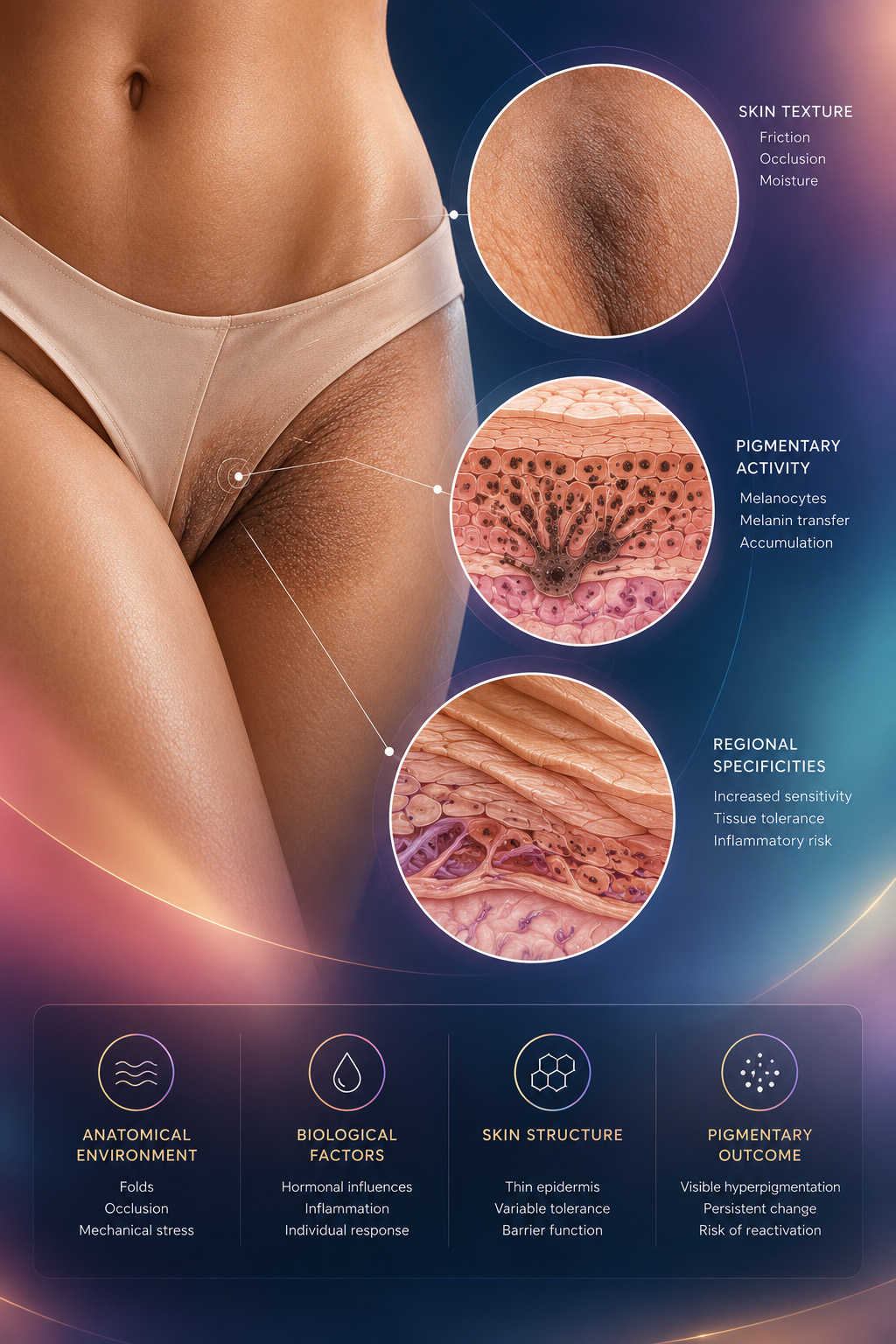
Clinical illustration showing intimate hyperpigmentation, regional skin biology and pigmentary activity
02
Clinical Topic Regional Skin Biology
Clinical Definition 02

Why Intimate Skin Is Different

Intimate hyperpigmentation describes increased visible pigmentation affecting external intimate and adjacent intertriginous skin. It should not be approached as ordinary facial or body pigmentation simply occurring in another location.

Clinical Distinction

Anatomical location changes the therapeutic context. Occlusion, friction, moisture, local sensitivity and the tendency toward inflammatory pigmentary change must all be considered before treatment intensity is selected.

01

Friction & Occlusion

Repeated mechanical contact and occlusive conditions may influence both pigmentation and treatment tolerance.

02

Variable Sensitivity

Tolerance is not uniform across intimate and adjacent cutaneous areas, making regional assessment essential.

03

Inflammatory Response

Irritation itself can perpetuate or intensify pigmentation, particularly in patients predisposed to pigmentary change.

04

Anatomical Precision

External cutaneous surfaces, folds and mucosal structures are not therapeutically interchangeable and must be distinguished clinically.

The first question is therefore not “How can this area be lightened?” but “What tissue are we treating, and why is it pigmented?”

Anatomical Mapping 03

One Clinical Term. Different Anatomical Areas.

“Intimate hyperpigmentation” may involve several external cutaneous regions. Each exists within a different anatomical environment and should therefore be identified precisely before treatment is considered.

The anatomical treatment field must be defined before the therapeutic pathway.
Essential Anatomical Boundary

External cutaneous surfaces and mucosal structures are anatomically distinct and must not be considered therapeutically interchangeable.

Identify Tissue First
Clinical Anatomy External Cutaneous Territories
Zoom
Medical illustration showing external anatomical areas that may present intimate hyperpigmentation
03
Anatomical Reference External Skin · Folds · Adjacent Areas
01
External Cutaneous Area Regional Precision

External Vulvar Skin

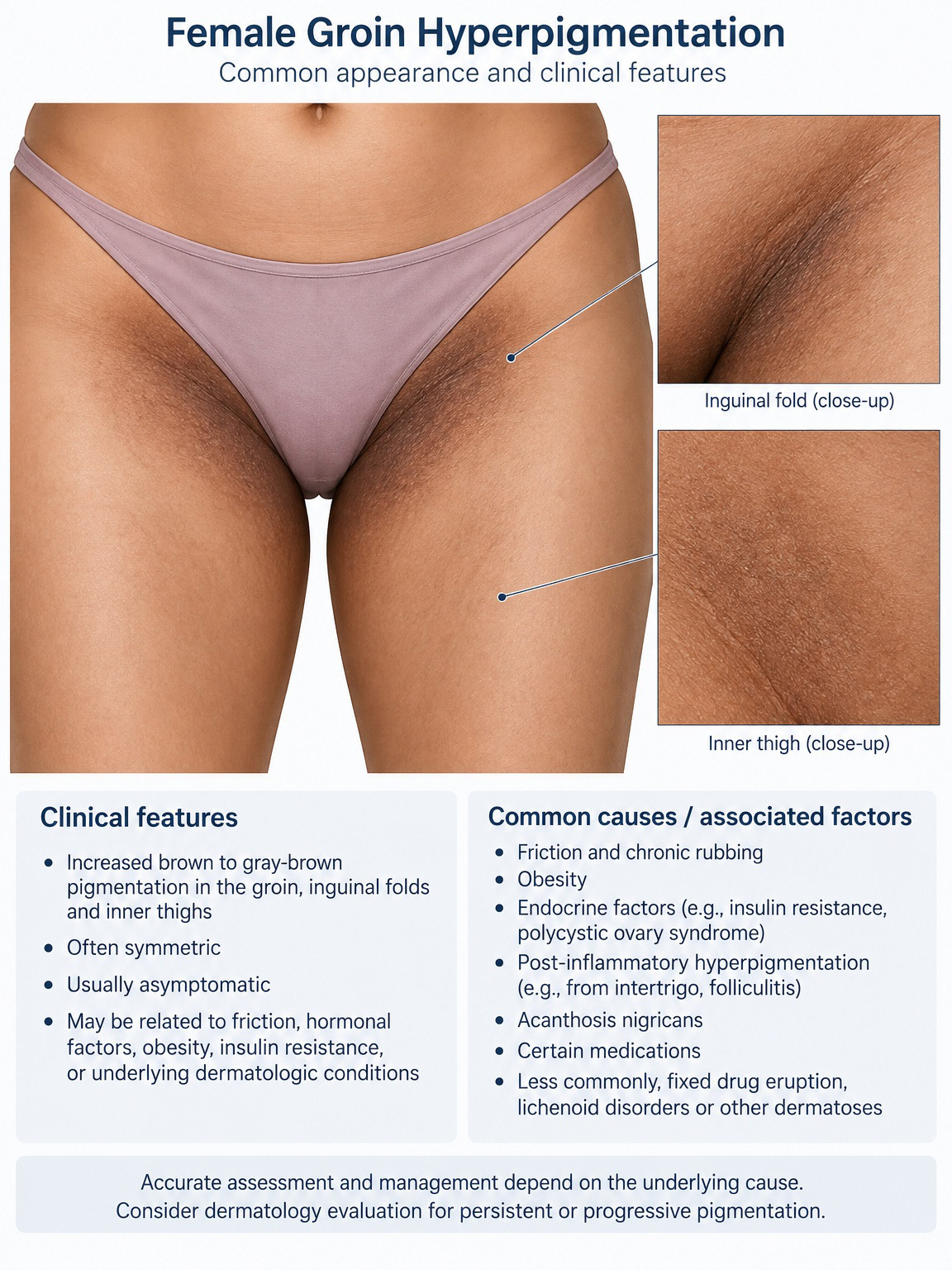
Pigmentation may involve external keratinized skin, particularly the labia majora and immediately adjacent cutaneous surfaces.

External Skin Variable Pigmentation Sensitivity
02
Intertriginous Area Fold Environment

Groin Folds

Groin pigmentation develops within an intertriginous environment where repeated contact, occlusion and moisture may influence the clinical presentation.

Friction Occlusion Moisture
03
Adjacent Cutaneous Area Extension Pattern

Inner Thighs

Pigmentation may extend beyond the folds onto adjacent thigh skin, where mechanical contact and previous inflammatory episodes may contribute to visible change.

Mechanical Contact PIH Distribution
04
External Cutaneous Area High Precision

Perianal Skin

External perianal pigmentation represents a distinct anatomical context in which the cutaneous treatment field must be defined with particular precision.

External Skin Boundaries Tolerance
Clinical Presentation

What Should Be Described Before Treatment?

Observe Before You Correct
01
Distribution Localized, diffuse or extending beyond the fold
02
Symmetry Symmetrical or predominantly unilateral
03
Colour Pattern Uniform, irregular or heterogeneous pigmentation
04
Skin Condition Intact, irritated or showing inflammatory change
03
From Anatomy to Strategy

Location defines the treatment field — not the protocol. Once the anatomical area has been identified, the next step is to determine the mechanism responsible for the pigmentation.

Anatomy → Mechanism
Anatomical Areas & Clinical Presentation
Pigmentary Drivers 04

What Drives Intimate Hyperpigmentation?

Visible pigmentation may be the final expression of several interacting biological and environmental influences. Identifying the dominant driver is more informative than describing colour alone.

The same visible pigmentation can arise from different clinical mechanisms.
01 Mechanical

Repetitive Friction

Recurrent rubbing or mechanical contact may maintain low-grade irritation and progressively reinforce visible pigmentation.

Repeated Contact → Irritative Signal → Pigmentary Change
02 Inflammatory

Post-Inflammatory Pigmentation

Previous irritation, dermatitis, follicular inflammation, shaving-related trauma or other inflammatory events may leave persistent pigmentary change after the visible inflammation has resolved.

Inflammation → Recovery → Residual Pigment
Clinical Expression Persistent Pigmentary Signal

Often multifactorial rather than driven by one isolated cause.

Mechanism Before Treatment

Determine what continues to stimulate or maintain the pigmentation before deciding how aggressively it should be corrected.

03 Hormonal

Hormonal Influence

Hormonal context may influence regional pigmentation and contribute to variation over time, particularly when other local pigmentary stimuli are also present.

Hormonal Context → Regional Influence → Visible Change
04 Individual

Constitutional Pigmentary Tendency

Baseline pigmentation and individual reactivity influence both the clinical appearance and the tendency to develop additional pigmentation after irritation.

Baseline Biology → Individual Response → Variable Expression
05
Perpetuating Factor

Repeated External Irritation

Hair removal, aggressive cleansing, unsuitable topical products and repeated cosmetic manipulation may become continuing sources of irritation. In such cases, treatment without correcting the trigger may reproduce the same pigmentary environment.

External Trigger → Repeated Irritation → Recurrence
Clinical Reality

Mechanisms Frequently Overlap

Friction + Inflammation + Individual Reactivity = Persistent Pigmentation

A multifactorial presentation should not be reduced to a single presumed cause. The relative importance of each driver must be established clinically.

From Mechanism to Assessment

Once the likely drivers have been identified, the next step is to determine whether the patient and the affected tissue are appropriate for treatment.

Mechanism → Assessment
Pre-Treatment Decision 05

Clinical Assessment & Treatment Eligibility

Identifying pigmentation is not sufficient to justify immediate treatment. The clinician must first determine whether the tissue is suitable for intervention, whether relevant risk factors are controlled and whether the clinical presentation requires further evaluation.

Assessment determines whether to treat, when to treat and when not to treat.
Clinical Gate Four decisions before treatment
Assess → Exclude → Stratify → Decide
01
First Gate

Assess

Observe

Establish the current condition of the treatment field before considering any corrective intervention.

✓

Skin integrity Intact surface without clinically significant irritation or disruption.

✓

Current clinical activity Determine whether erythema, inflammation, discomfort or other active changes are present.

✓

Clinical history Document onset, evolution, previous procedures and prior responses to topical or procedural treatment.

02
Safety Gate

Exclude

Verify

Pigmentation should not automatically be interpreted as an indication for a cosmetic or corrective procedure.

!

Active inflammatory disease Defer treatment when clinically significant inflammation is present.

!

Infection or suspicious lesion Findings requiring diagnosis or medical management take priority over pigment correction.

!

Uncertain diagnosis Atypical, evolving or unexplained pigmentation should be clarified before elective treatment.

03
Risk Gate

Stratify

Estimate

Estimate individual susceptibility before choosing treatment intensity or therapeutic pathway.

+

Phototype Record phototype as one component of the overall pigmentary risk assessment.

+

History of PIH Previous post-inflammatory pigmentation may indicate greater susceptibility to pigmentary rebound.

+

Previous tolerance Consider the response to earlier procedures, irritation and recovery rather than treatment history alone.

04
Decision Gate

Decide

Select

Integrate the clinical findings before moving from assessment to treatment planning.

→

Treatment readiness Determine whether the tissue is clinically suitable for intervention now.

→

Need for stabilization Correct modifiable local conditions before attempting pigment correction when necessary.

→

Need for referral Do not proceed when diagnosis, pathology or clinical findings require investigation beyond the intended procedure.

Patient-Specific Context

Clinical Eligibility Is More Than Skin Examination

Treatment planning should also account for circumstances that may alter tolerance, recovery, adherence or the interpretation of the expected result.

01
Recent Procedures Hair removal, exfoliation or other recent local procedures.
02
Current Topicals Products capable of irritating or altering local tolerance.
03
Recovery Conditions Ability to minimize avoidable irritation during recovery.
04
Patient Expectations Goals should be clinically realistic and compatible with gradual pigmentary management.
Treatment Eligibility

Three Possible Clinical Decisions

Assessment → Action
✓
Eligible

Proceed

The treatment field is clinically suitable and no identified finding requires prior stabilization or further investigation.

≈
Temporarily Deferred

Stabilize First

Modifiable irritation, inflammation or another temporary condition should be controlled before reassessment.

!
Further Evaluation

Do Not Treat & Refer

Uncertain diagnosis, suspicious findings or relevant pathology requires appropriate medical evaluation before elective pigment treatment.

05
Eligibility Before Strategy

A treatment pathway begins only after eligibility has been established. The next step is to understand which pigmentary compartments should be targeted and regulated.

Eligibility → Pigment Model
Metabolic Pigmentation Science 06

Tenenbaum–Tiziani Metabolic Pigmentation Model

Visible pigmentation represents more than the presence of melanin. It reflects a dynamic biological sequence involving pigment formation, cellular transfer and the progressive handling of pigment already present within the epidermal system.

Effective pigment management can therefore be considered across several interconnected metabolic compartments.
TT
Core Concept

Pigmentation Is a Dynamic System

The therapeutic objective is not limited to removing visible pigment. A metabolic strategy considers how pigment is produced, how it is transported and how existing pigment is progressively degraded and cleared.

Mechanism → Compartment → Strategy
01
Compartment One

Melanin Production

The first compartment concerns the biological activity responsible for pigment formation. Excessive or persistent melanogenic activity can continue to replenish visible pigmentation even when existing surface pigment is reduced.

Therapeutic Focus Regulate excessive pigment formation
02
Compartment Two

Melanin Transport

Pigment must also be considered in terms of its transfer and distribution within the epidermal system. Regulation at this level addresses the movement of melanin rather than its synthesis alone.

Therapeutic Focus Modulate pigment transfer and distribution
03
Compartment Three

Degradation & Clearance

Existing pigment represents a third therapeutic dimension. Progressive epidermal processing and elimination influence how long previously formed pigment remains clinically visible.

Therapeutic Focus Facilitate progressive handling of existing pigment
Transversal Modulator

Inflammatory Signalling

Inflammatory signalling is not presented here as a fourth melanin compartment. It acts across the pigmentary system and may modify melanogenic activity, tissue response and the persistence of pigmentary change.

Production Transport Clearance
Conceptual Difference

Visible Pigment vs. Pigment Dynamics

These two perspectives should not be confused. One describes what is visible at a given moment; the other considers the biological processes that continually determine that visible result.

A Static Perspective

Visible Pigment

Focuses primarily on pigment already clinically apparent within the treatment field.

What is visible now
VS
B Metabolic Perspective

Pigment Dynamics

Considers the continuing balance between pigment formation, transfer and progressive clearance.

What determines pigmentation over time
TT
Tenenbaum–Tiziani Principle

Three Compartments. One Pigmentary System.

Production + Transport + Degradation / Clearance = Pigmentary Balance

The relative importance of each compartment may differ between patients and clinical presentations. This provides a framework for selecting a therapeutic strategy rather than assuming that every pigmentation problem requires the same form of correction.

From Model to Treatment

Once the pigmentary system is understood, treatment can follow different therapeutic pathways according to the clinical objective and the required degree of correction or regulation.

Metabolic Model → Two Pathways
Therapeutic Strategy 07

Two Therapeutic Pathways

Once treatment eligibility and the pigmentary model have been established, the therapeutic objective can follow two distinct but potentially complementary pathways: controlled correction of visible pigmentation or progressive metabolic regulation.

The choice is strategic: correct what is visible, regulate what sustains pigmentation, or combine both approaches sequentially.
A B
Therapeutic Principle

Different Objectives. Different Biological Logic.

A corrective pathway primarily addresses clinically visible pigment through a controlled procedural endpoint. A metabolic pathway addresses pigmentary dynamics progressively over time.

Select the Objective First
A
Corrective Pathway

Controlled Correction

Frosting-Based

A more directly corrective strategy directed toward visible pigmentation, using a deliberately controlled clinical endpoint within an appropriately selected treatment field.

01 Visible Pigment Defined corrective target
→
02 Controlled Action Deliberate treatment intensity
→
03 Clinical Endpoint Observable procedural response
✦
Key Concept Frosting is an endpoint — not a treatment objective by itself.

Its significance depends on the selected agent, anatomical site, tissue tolerance and intended depth of controlled correction.

OR AND
B
Regulatory Pathway

Metabolic Regulation

Progressive

A progressive strategy directed toward the biological dynamics that determine pigmentation rather than toward visible pigment alone.

01 Pigment Dynamics Metabolic framework
→
02 Regulation Progressive modulation
→
03 Pigmentary Balance Longitudinal objective
∞
Key Concept Regulation addresses pigment dynamics rather than pigment visibility alone.

It may target one or more pigmentary compartments described in the Tenenbaum–Tiziani metabolic model.

Clinical Integration

Not Necessarily Either / Or

The two pathways describe different therapeutic objectives, but they are not necessarily mutually exclusive. In selected cases, controlled correction may be followed by progressive regulation of the pigmentary environment.

01 Initial Objective Correction
→
02 Biological Objective Regulation
→
03 Long-Term Objective Maintenance
!

This sequence represents a therapeutic concept, not a universal protocol. The appropriate pathway depends on the clinical assessment, treatment field and intended objective.

Strategic Comparison

Two Pathways, Two Primary Objectives

Primary Focus
Visible established pigmentation
Pigmentary dynamics
Approach
Controlled corrective intervention
Progressive biological regulation
Endpoint Logic
Observable controlled response
Progressive change over time
Strategic Role
Correction
Regulation
Controlled Correction Metabolic Regulation
A B
From Strategy to Selection

Once the therapeutic pathway has been defined, the next question is which product and protocol best match that objective.

Pathway → Product & Protocol
Clinical Selection Framework 08

Product & Protocol Selection

Product selection follows the therapeutic objective. Corrective acids, post-acid transition products and metabolic regulators do not occupy the same position within the treatment sequence.

Select the pathway first, then place each product in its correct clinical sequence.
Essential Sequence

When a Corrective Acid Is Used

The order of application is fundamental. Peeling de Luxe Plus occupies the transition between the corrective acid step and subsequent metabolic products.

01 Corrective Step TCA / Salicylic-Type Acid

Controlled acid application according to the selected corrective objective.

→
02 Mandatory Sequence Position Peeling de Luxe Plus

Applied after the acid step and before subsequent metabolic products.

→
03 Metabolic Step Metabolic Products

Selected according to the intended pigment-regulating objective.

!

Sequence rule: Peeling de Luxe Plus is positioned after an acid such as TCA or salicylic acid and before the application of other metabolic products.

01
Corrective Family

Controlled Acid Correction

Used when the selected therapeutic pathway includes a direct corrective step against established visible pigmentation.

TCA corrective peeling product
Corrective Acid Step

TCA-Based Correction

A controlled corrective option when a frosting-based pathway has been selected and the anatomical treatment field is considered suitable.

Position Before Peeling de Luxe Plus
Salicylic acid corrective peeling product
Corrective Acid Step

Salicylic-Type Correction

An alternative corrective acid approach when clinically appropriate within the selected treatment strategy.

Position Before Peeling de Luxe Plus
02
Post-Acid Transition

Peeling de Luxe Plus

A specific intermediate step within the corrective sequence, positioned after the acid application and before subsequent metabolic products.

Sequence Position Acid → Peeling de Luxe Plus → Metabolic
Peeling de Luxe Plus post-acid transition product
Peeling de Luxe Plus · Post-Acid Transition
Critical Sequence Step

After the Acid. Before Metabolic Products.

Peeling de Luxe Plus is not positioned as an isolated first-line acid step in this sequence. Its role follows the corrective acid application and precedes the products selected for subsequent metabolic management.

01

Post-Acid Position Used after the selected corrective acid step.

02

Frosting-Control Role Marks the controlled transition following the corrective acid phase.

03

Pre-Metabolic Position Applied before subsequent metabolic products.

!

Do not reverse the sequence: metabolic products belong after Peeling de Luxe Plus when the protocol includes a preceding corrective acid.

03
Metabolic Family

Progressive Pigment Regulation

Metabolic products are selected according to the pigmentary objective and their intended role within the regulatory strategy.

Clarté de Lune metabolic pigmentation treatment
Metabolic Pigment Regulation

Clarté de Lune

Positioned within the metabolic strategy for regulation of melanocyte activity and melanin-related pigmentation processes.

Clinical Role Melanocyte / Melanin Regulation
StretchPeel depigmenting metabolic treatment
Depigmenting Metabolic Protection

StretchPeel

A depigmenting component of the metabolic strategy, combining progressive pigment management with biological photoprotection against UVA- and UVB-related environmental stimulation.

Clinical Role Depigmentation + Biological Photoprotection
Lipoic Acid Cream metabolic treatment
Metabolic Penetration Support

Lipoic Acid Cream

Used within a metabolic strategy where enhanced penetration of associated active components forms part of the intended treatment logic.

Clinical Role Penetration Facilitator
Clinical Selection Logic

Product Choice Follows the Pathway

The same product sequence is not required for every patient. Selection depends on whether the objective is direct correction, progressive metabolic regulation or a planned combination of both.

A Corrective Pathway

Acid-Based Correction

Corrective Acid → Peeling de Luxe Plus

Selected when controlled correction of established visible pigmentation is the principal initial objective.

B Metabolic Pathway

Progressive Regulation

Metabolic Selection → Progressive Regulation

Selected when the therapeutic objective is progressive regulation rather than an initial frosting-based corrective step.

A+B Combined Strategy

Correction + Regulation

Acid → Peeling de Luxe Plus → Metabolic

Used when controlled correction is deliberately integrated with subsequent metabolic management.

01 02 03
Sequence Matters

Acid First. Transition Second. Metabolic Products After.

When the selected protocol begins with TCA, salicylic acid or another appropriate corrective acid, Peeling de Luxe Plus follows that acid step. Other metabolic products are applied only after this transition step within the intended protocol.

01 02 03
From Selection to Strategy

Product selection defines the therapeutic tools. The next step is to organize them longitudinally through correction, stabilization and maintenance.

Product Selection → Treatment Strategy

Share this page with your network