Accéder au contenu principal
Core Science · Metabolic Skin Modulation

Metabolic
Peels

A biological and functional approach to modern chemical peeling, focused on controlled stimulation, barrier preservation and intelligent skin response rather than visible injury alone.

Controlled Biology Barrier-Aware Precision Peeling
Metabolic peels paradigm shift in chemical peeling
Metabolic peels introduce a biological reading of chemical peeling: not only acid strength, but skin response, barrier status and protocol intelligence.
Core Science · Paradigm Shift

The Classic Peel Model
Has a Conceptual Flaw

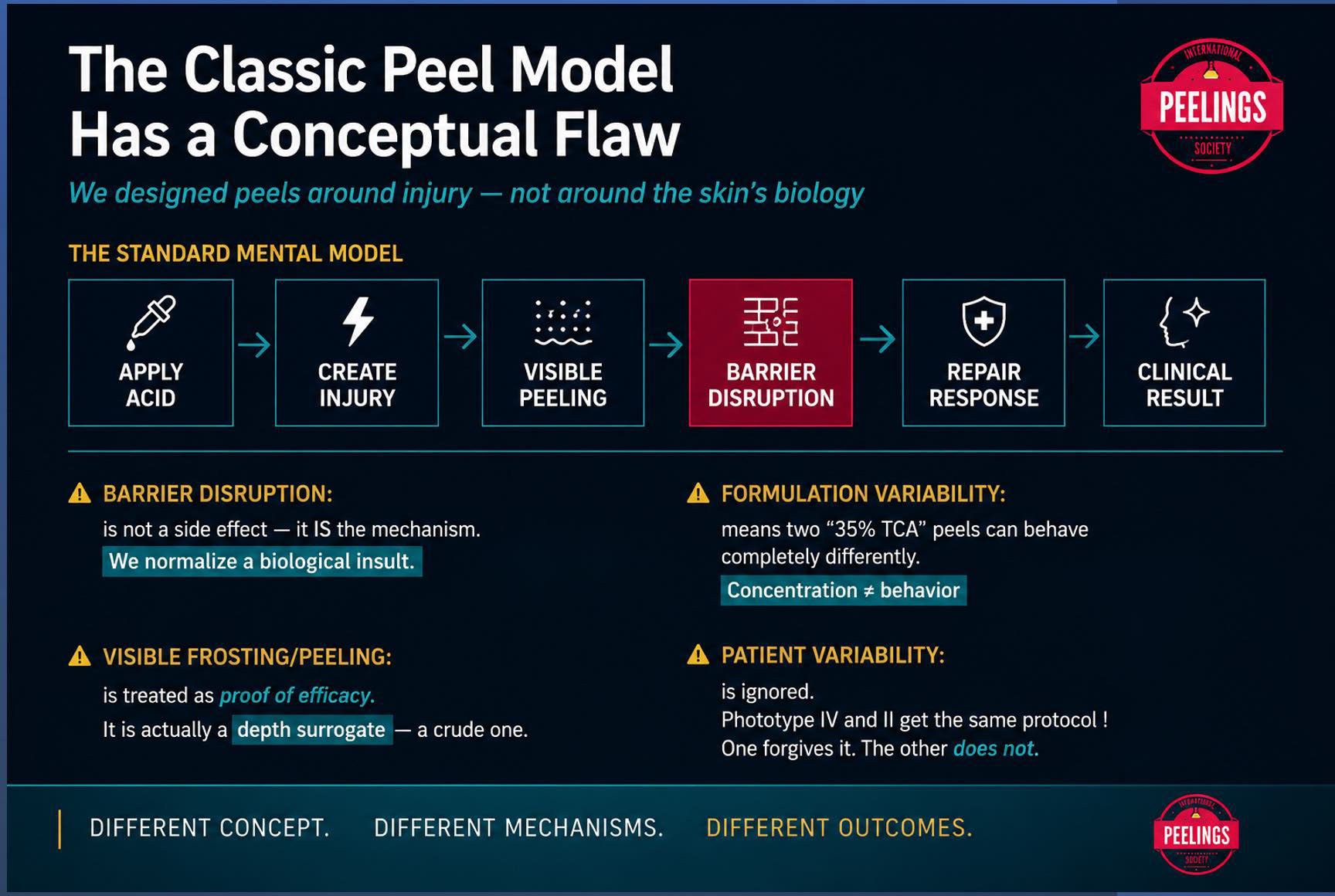
Traditional chemical peeling has often been taught through the visible intensity of injury: concentration, frosting, exfoliation and downtime. This approach is useful, but incomplete.

Skin response is not determined by acid percentage alone. It depends on pH, buffering, vehicle, barrier status, application protocol, tissue context and the biological target reached by the formulation.

The classic peel model has a conceptual flaw
Classical peeling models often overemphasize concentration and visible injury, while metabolic peels introduce a broader biological interpretation of skin response.
Core Science · Biological Definition

What Defines
a Metabolic Peel?

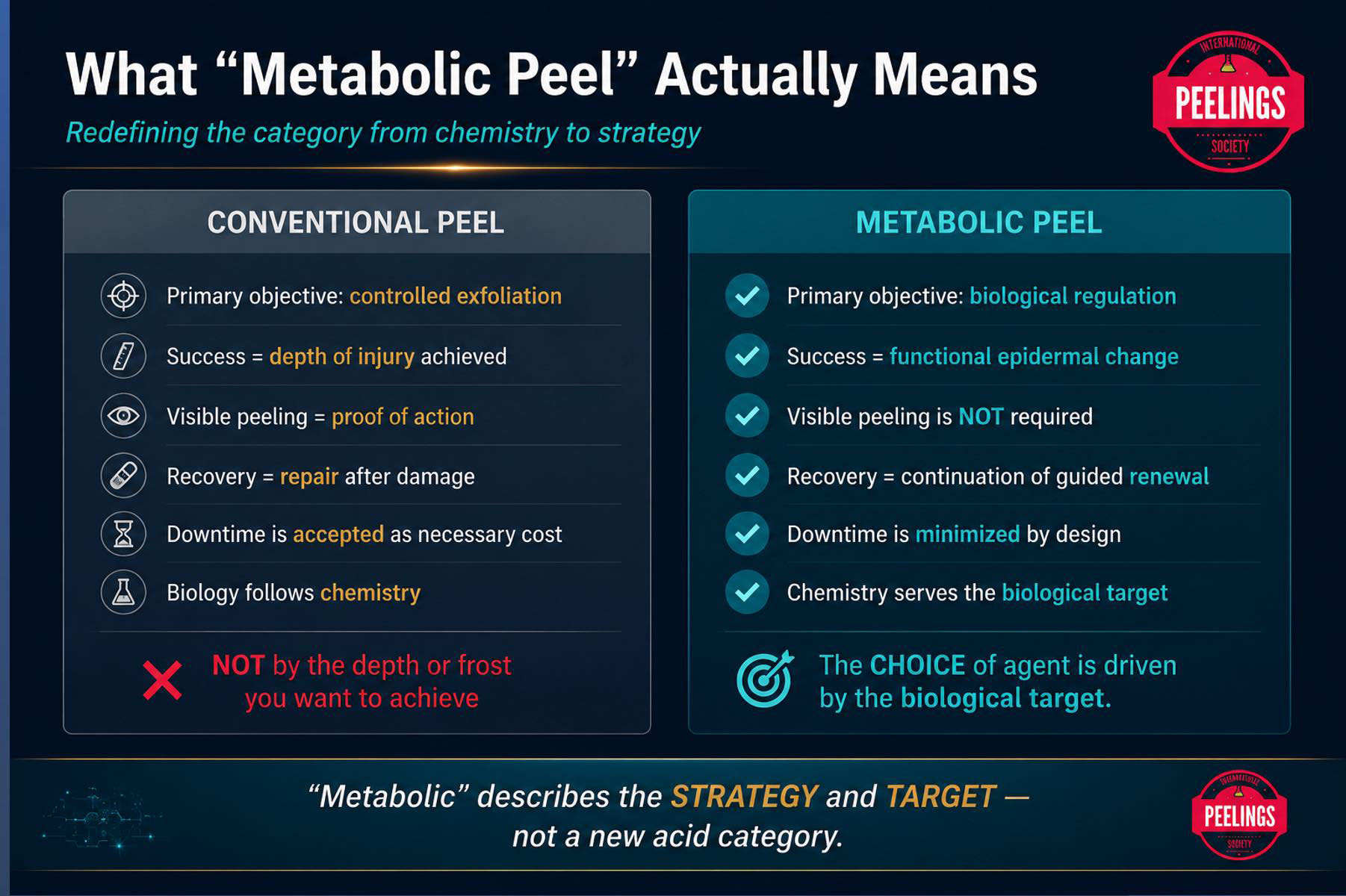
A metabolic peel is not simply a lighter peel. It is a biologically oriented procedure designed to interact with skin physiology rather than relying only on visible destruction.

The objective is to guide the skin toward a controlled response: barrier-aware stimulation, regulated inflammation, functional renewal and tissue adaptation without making injury the central endpoint.

What is a metabolic peel concept
A metabolic peel is not defined by weakness or aggression, but by the biological control of skin response.
Core Science · pH, pKa and Ionization

Acid Percentage
Is Not Enough

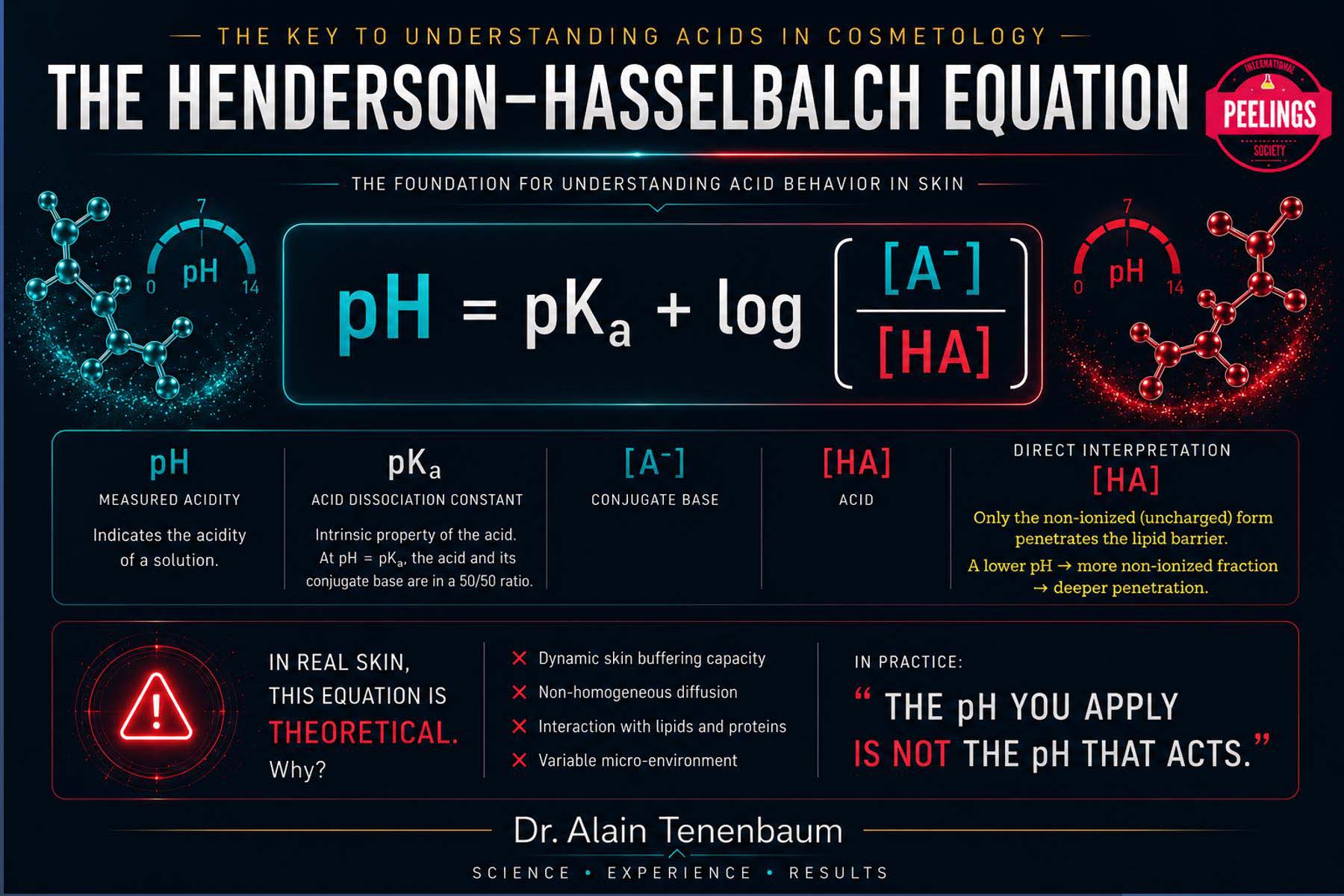
The biological effect of an acid cannot be predicted by concentration alone. A peel applied at the same percentage may behave differently depending on pH, pKa, ionization, buffering and skin barrier status.

The Henderson–Hasselbalch relationship helps explain why the active non-ionized fraction of an acid is critical for diffusion and tissue interaction. In metabolic peeling, this becomes part of protocol intelligence rather than a simple numerical strength.

Henderson Hasselbalch acid penetration model for metabolic peels
The Henderson–Hasselbalch model illustrates why acid behavior in the skin depends on ionization balance, pH dynamics and diffusion—not on concentration alone.
Core Science · Acid Interaction Dynamics

The Tenenbaum–Tiziani
Acid Interaction Model

Different acids do not interact with skin biology in the same way. Their behavior depends on diffusion, penetration, buffering, molecular profile and tissue response—not simply on concentration.

Tenenbaum Tiziani acid interaction model for metabolic peels
The Tenenbaum–Tiziani model supports a functional interpretation of acid behavior: each acid must be understood through its biological interaction profile, not only through its nominal percentage.
Core Science · Protonic Profile and Skin Interaction

Not All Acids
Behave the Same Way

Chemical peels cannot be understood as interchangeable acids applied at different percentages. Monoprotic, diprotic and triprotic acids may generate different diffusion profiles, buffering patterns and biological interactions within the skin.

In metabolic peeling, the clinical strategy depends on how each acid behaves in tissue: how it releases protons, how it is buffered, how it diffuses and how the skin interprets the resulting signal.

Acid interaction table for metabolic peels
Acid interaction is not uniform: protonic profile, buffering behavior and tissue context influence how a peel acts biologically beyond nominal concentration.
Core Science · Biological Signaling

The Skin Responds
to Signals

Skin biology does not interpret chemical peeling only as acid contact. It responds to biological signals generated by dose, target layer, barrier status, inflammation and cellular context.

This is the central logic of metabolic peels: the clinical goal is not simply to injure tissue, but to create a controlled biological message that the skin can translate into repair, renewal and functional adaptation.

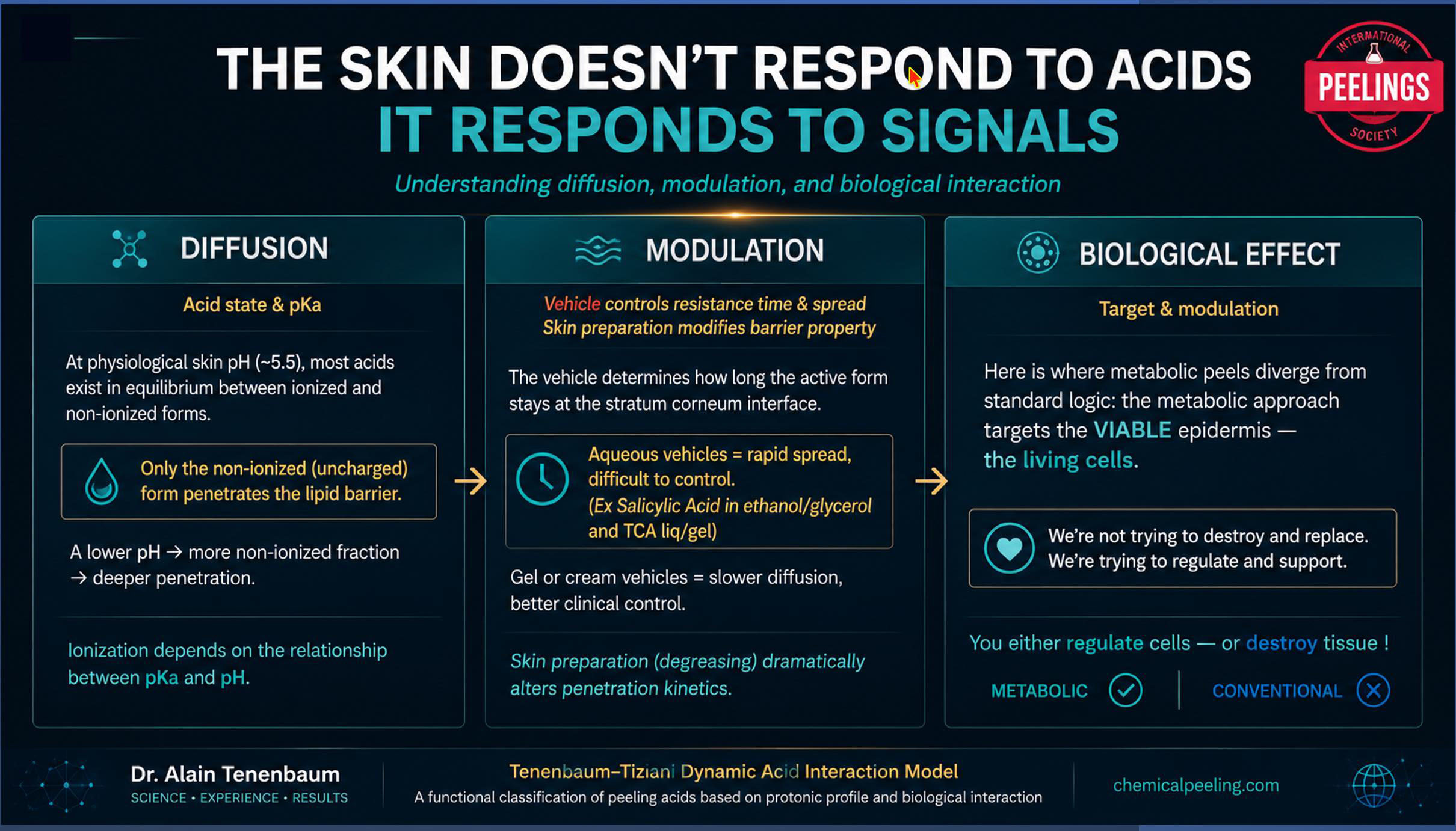
The skin does not respond to acids it responds to signals
In metabolic peeling, acids are not considered isolated aggressive agents. They are interpreted through the biological signals they generate within the skin.
Core Science · Clinical Target Logic

Two Different Targets
Two Clinical Logics

Conventional injury-based peeling and metabolic peeling do not pursue the same biological objective. One is mainly organized around tissue removal and visible injury; the other around controlled response, barrier-aware stimulation and functional modulation.

This distinction is essential because the target determines the protocol. A peel designed to remove tissue is not interpreted by the skin in the same way as a peel designed to generate a controlled biological signal.

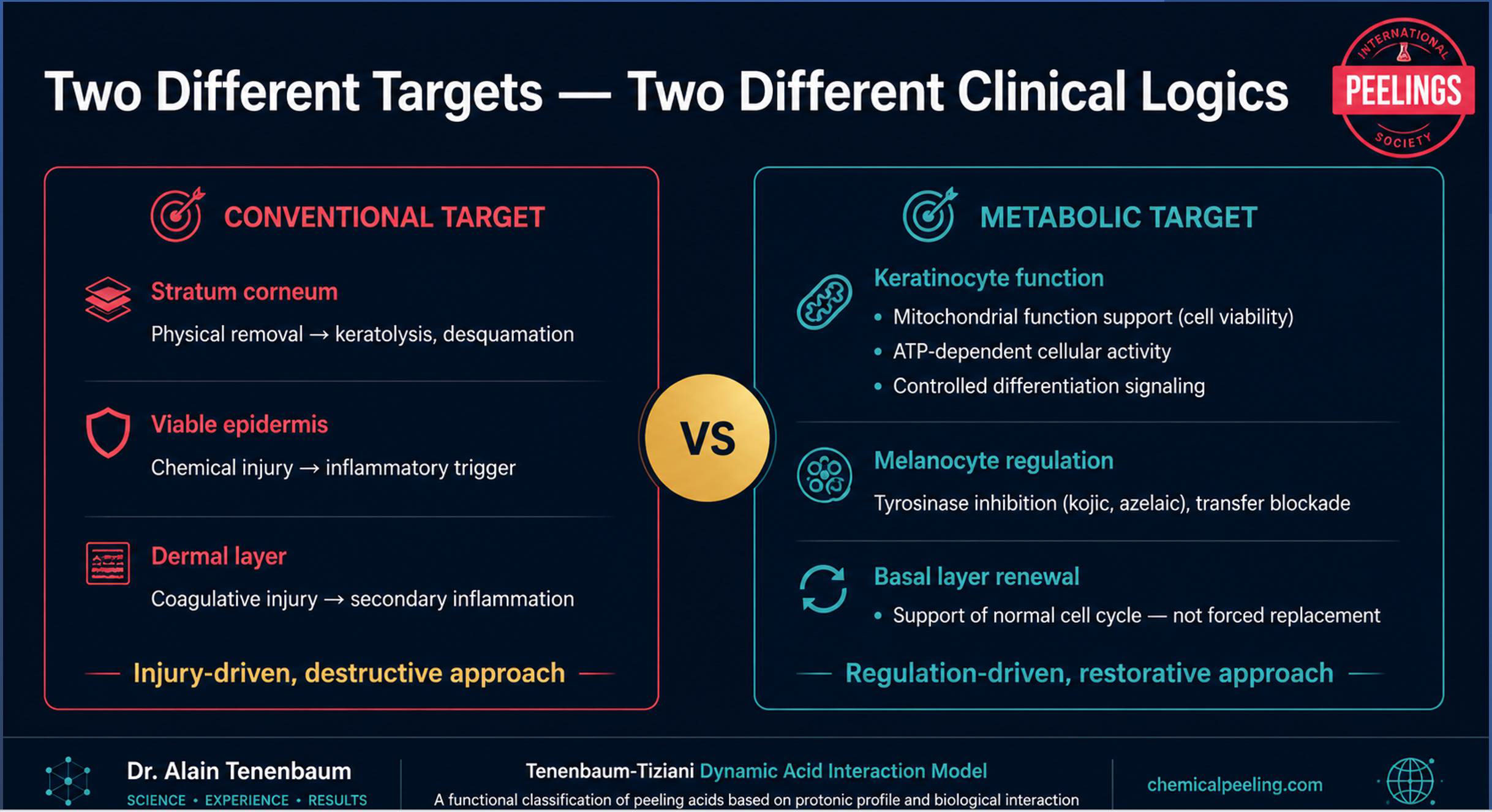
Two different targets two different clinical logics
The clinical logic of a peel depends on its biological target: visible injury and tissue removal do not generate the same skin response as controlled metabolic stimulation.
Core Science · Penetration and Buffering

Chemical Penetration
Meets Biological Buffering

Penetration potential does not automatically equal biological effect. Once an acid reaches the skin, tissue buffering, barrier status and local biological response modify its real clinical behavior.

This is why metabolic peeling cannot be reduced to acid strength alone: the skin is not a passive target, but an active biological interface.

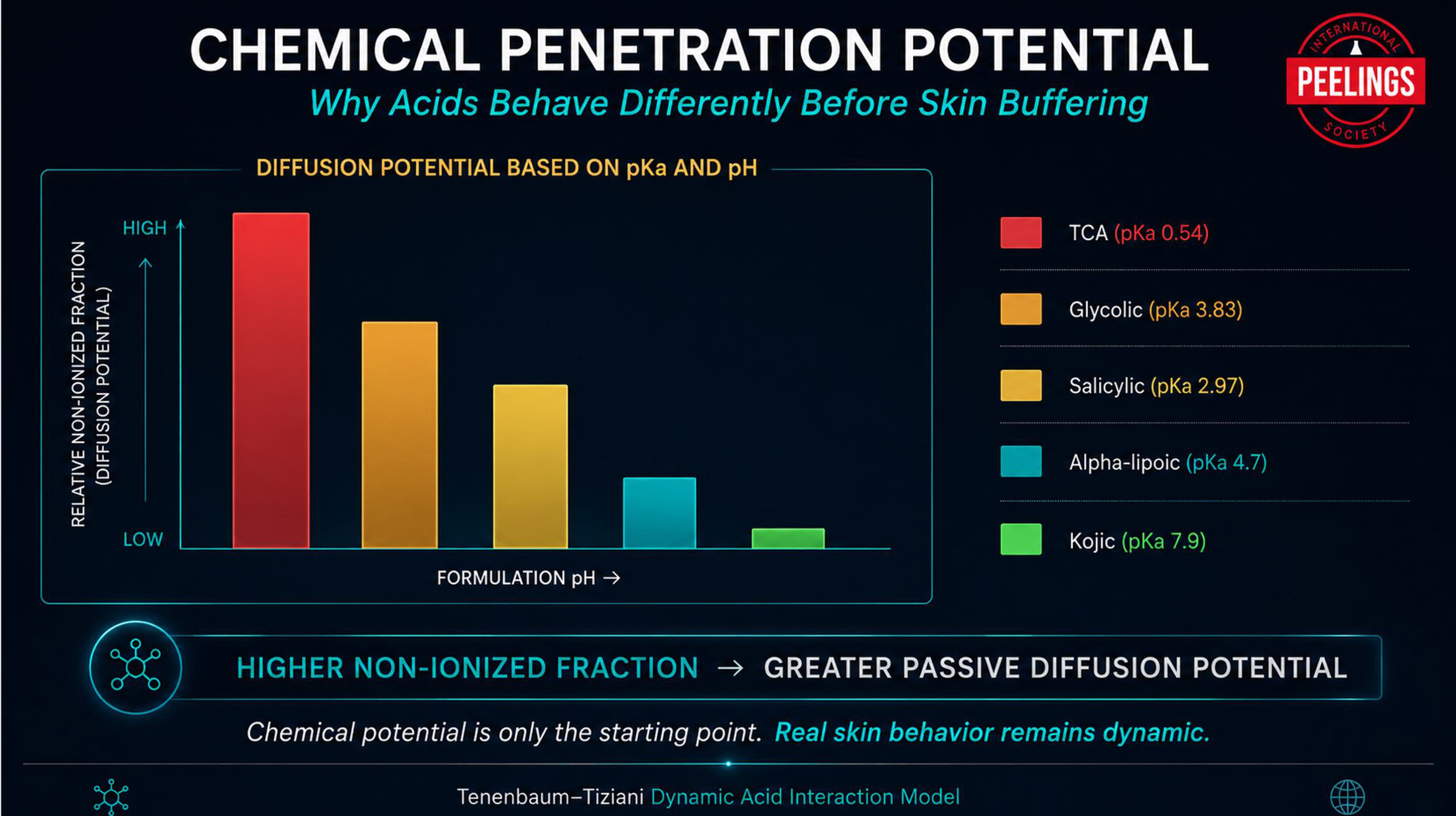
Chemical penetration potential model in metabolic peels
Chemical penetration potential describes the theoretical ability of an acid to diffuse and interact with tissue before biological modulation occurs.
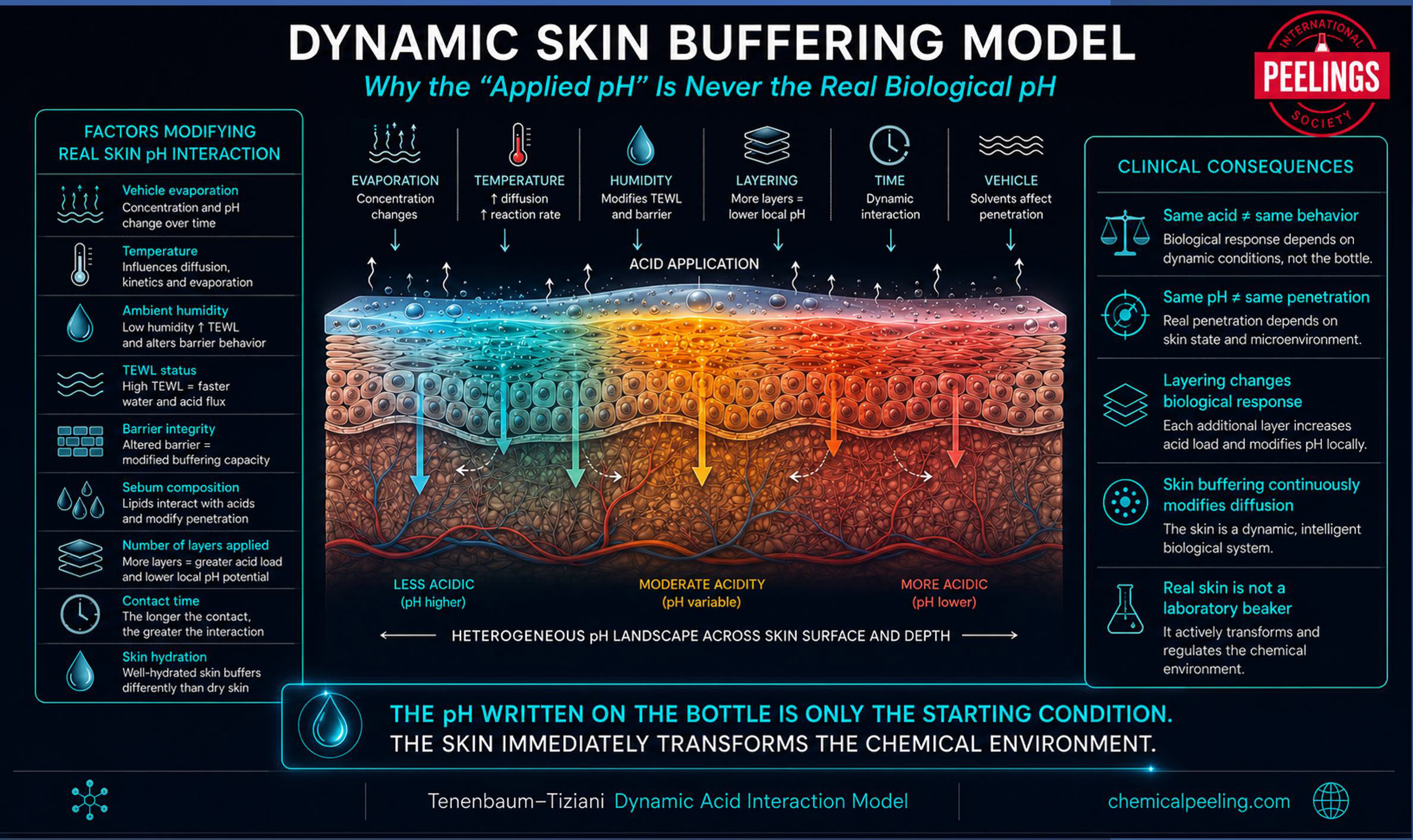
Dynamic skin buffering model in metabolic peels
Dynamic skin buffering explains why the final biological effect depends on tissue context, not only on the applied acid formulation.
Core Science · Scientific Comparison

Metabolic vs
Standard Peels

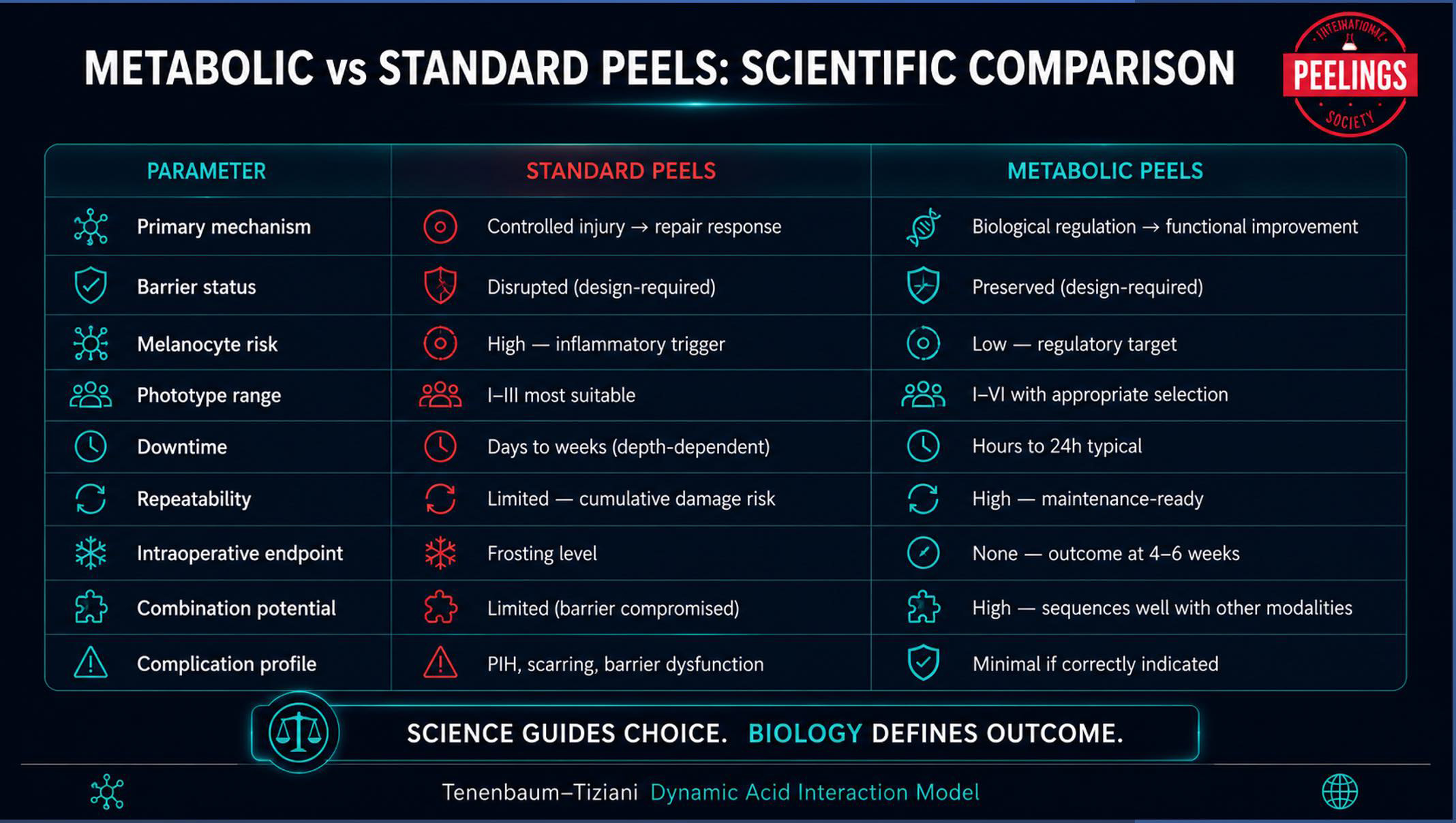
Standard peels and metabolic peels should not be understood as two versions of the same procedure. They correspond to different biological philosophies, different clinical endpoints and different risk profiles.

The decisive question is not simply how strong the peel is, but whether the protocol is designed around controlled injury or around biological regulation and functional improvement.

Metabolic vs standard peels scientific comparison
This comparison highlights the difference between injury-centered peeling and biologically regulated metabolic peeling, where barrier preservation, repeatability and controlled response guide clinical choice.
Core Science · Phototype Biology

Phototype Risk
Changes Everything

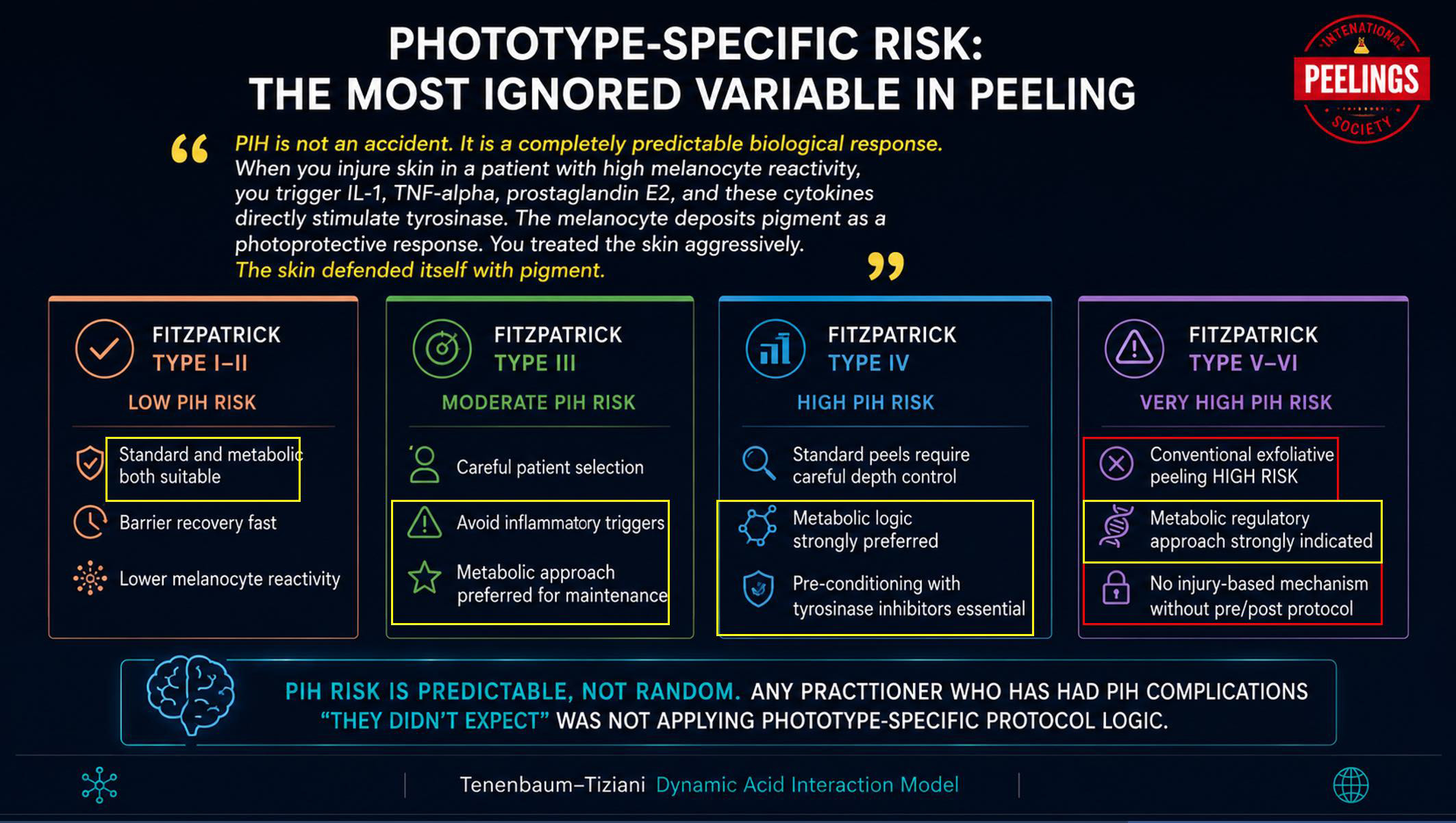
Skin phototype is not a cosmetic detail. It changes inflammatory behavior, melanocyte reactivity and the probability of post-inflammatory hyperpigmentation after chemical peeling.

A metabolic approach gives greater importance to biological stability, barrier preservation and controlled signaling, especially in patients where excessive inflammation may amplify pigmentary instability.

Phototype specific risk in chemical peeling
Phototype-specific risk explains why the same chemical procedure may generate different biological consequences depending on melanocyte sensitivity, inflammation and barrier status.
Core Science · Clinical Translation

When Metabolic Peels
Become Clinically Preferable

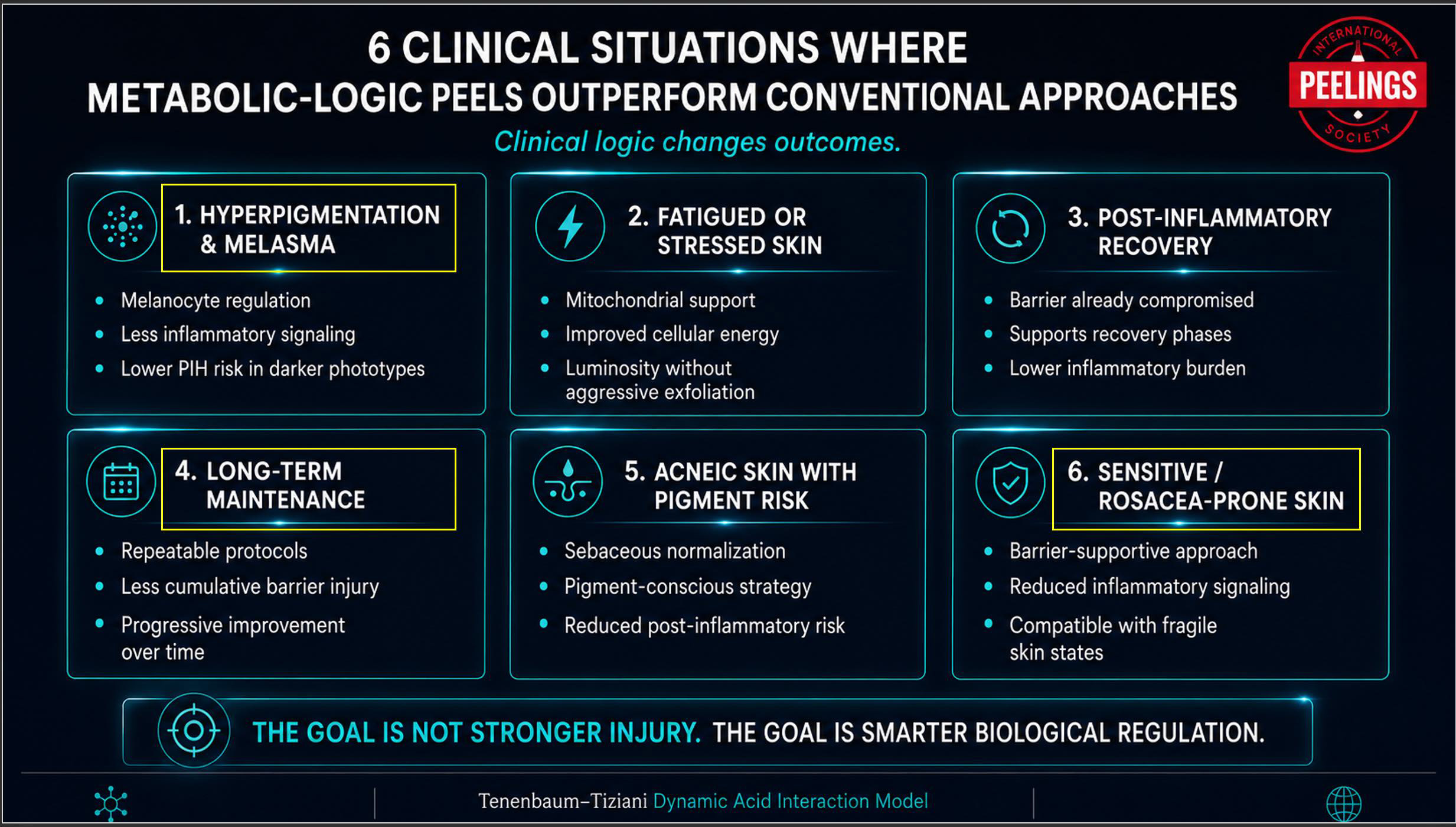
Metabolic peels become particularly relevant when excessive inflammation, barrier disruption or uncontrolled tissue injury could compromise the clinical outcome.

Their value is not based on being weaker, but on being more biologically selective: the protocol is adapted to the indication, the phototype, the barrier status and the desired tissue response.

When metabolic peels become clinically preferable
Certain clinical situations benefit from metabolic logic because the goal is not stronger injury, but better biological decision-making and safer tissue response.
Core Science · Future Perspectives

The Future of Peeling
Is Protocol Intelligence

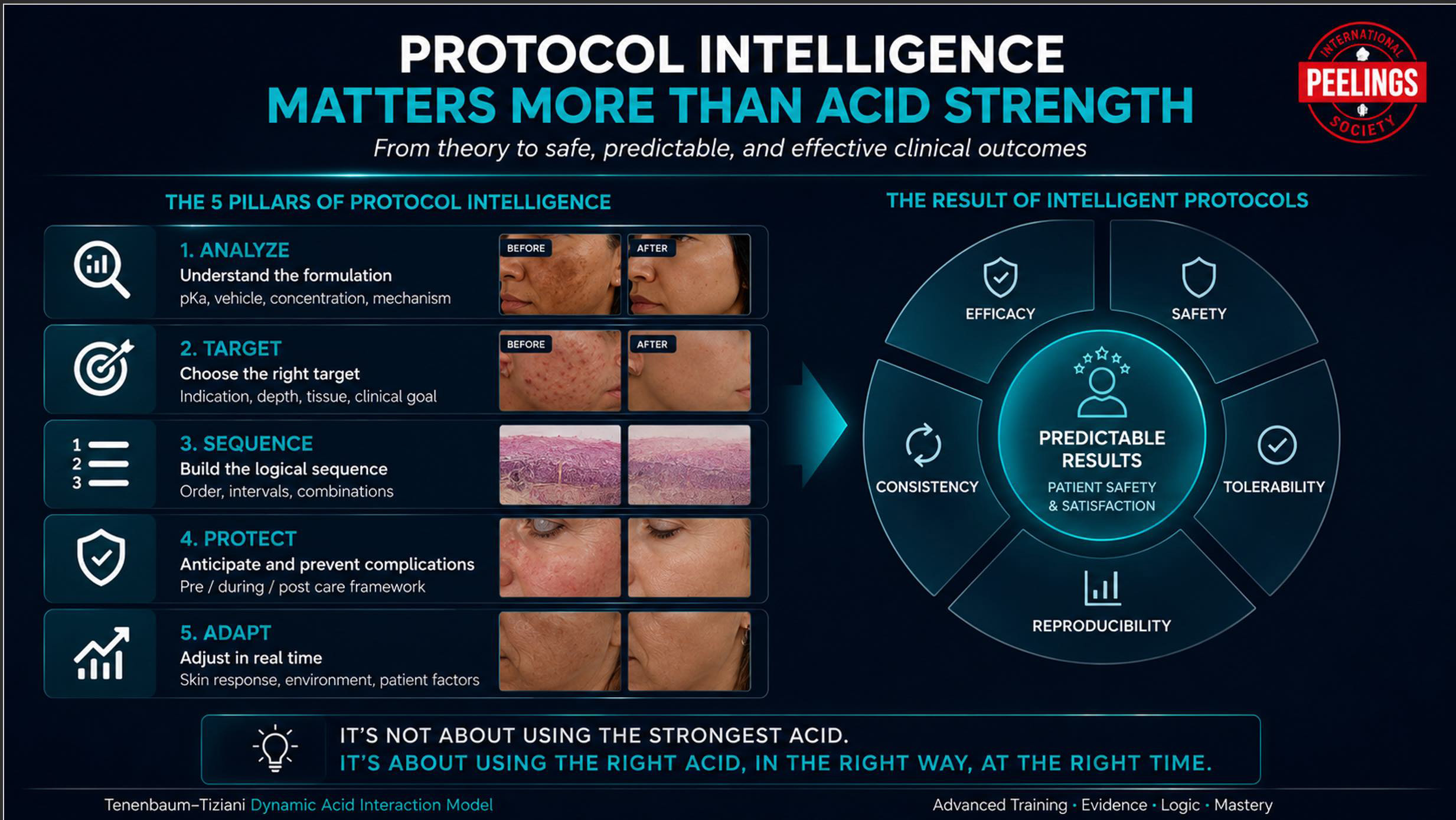
The next evolution of chemical peeling is unlikely to depend on stronger acids or deeper visible injury. It will depend on protocol intelligence: understanding how skin biology reacts, adapts and regenerates.

Metabolic peeling introduces a more adaptive vision of skin intervention, where concentration alone is no longer the dominant variable. Biological context, barrier status, inflammation control and tissue signaling become central elements of protocol design.

Future of peeling is protocol intelligence
The future of peeling may progressively move from aggressive standardized procedures toward biologically adaptive and intelligently designed protocols.
Core Science · Closing Perspective

Toward Intelligent
Skin Modulation

Metabolic peels represent a transition from aggressive exfoliation toward biologically guided skin intervention.

The future of chemical peeling may depend less on producing stronger visible injury and more on understanding how the skin receives, buffers and translates controlled biological signals.

Toward intelligent skin modulation
Metabolic peeling reframes chemical peeling as a controlled biological dialogue between formulation, barrier function, tissue response and protocol intelligence.
Core Science · Key Takeaways

What This Changes
in Clinical Thinking

Metabolic peeling reframes chemical peeling as a biological decision, not merely a chemical aggression. The central question becomes how the skin interprets the intervention.

01

Acid percentage is not enough

Concentration alone cannot predict penetration, tissue interaction or biological response.

02

The skin is not passive

Barrier status, buffering and inflammatory context actively modify clinical outcomes.

03

Signals matter more than visible injury

The clinical endpoint should not be reduced to frosting, peeling or downtime.

04

Phototype changes risk

Melanocyte reactivity and inflammation require biologically adapted protocol decisions.

05

Barrier-aware protocols matter

Preserving functional skin response may be more valuable than producing excessive disruption.

06

Protocol intelligence is the future

The next generation of peeling depends on biological precision, not stronger acids alone.

Scientific FAQ · Metabolic Peels

Frequently Asked
Scientific Questions

These questions summarize the core scientific logic behind metabolic peels, biological response, barrier preservation and protocol intelligence.

Are metabolic peels simply weaker peels?

No. A metabolic peel is not defined by weakness. It is defined by a biologically controlled approach to skin response, where stimulation, barrier status and tissue signaling are considered more important than visible aggression alone.

Why is acid percentage alone insufficient?

Acid percentage does not fully predict biological behavior. pH, pKa, ionization, buffering, vehicle, skin barrier condition and application protocol all influence penetration and clinical response.

Do metabolic peels avoid skin injury completely?

Not necessarily. The aim is not to deny tissue interaction, but to avoid making uncontrolled injury the central endpoint. The goal is controlled stimulation and biologically appropriate response.

Why is skin buffering important?

Skin buffering modifies acid behavior after application. The skin is an active biological interface, not a passive surface. This is why the same acid may behave differently depending on tissue context.

Are metabolic peels relevant for darker phototypes?

They may be particularly relevant when excessive inflammation or barrier disruption could increase the risk of pigment instability. Phototype, melanocyte reactivity and inflammatory tendency should guide protocol decisions.

What is protocol intelligence in chemical peeling?

Protocol intelligence means adapting the peel to the patient, indication, barrier status, phototype, inflammatory risk and desired biological response, rather than relying on stronger acids or deeper visible injury.

Scientific Notice · Ethical Use

Scientific and
Educational Notice

The information presented on this page is intended for scientific, educational and professional understanding of metabolic peeling concepts.

It does not replace individualized medical judgment. Chemical peeling protocols should always be adapted to the patient, skin condition, phototype, barrier status, clinical indication and professional level of expertise.

Products and protocols discussed within this scientific framework should be used responsibly by trained professionals, with attention to safety, tissue response and ethical clinical decision-making.

Scientific Support · References

Selected Scientific
References

The concepts discussed on this page are connected to broader scientific literature on chemical peeling, skin barrier function, inflammation, pigmentation risk and tissue response.

01

Scientific literature on chemical peeling mechanisms, acid penetration, controlled exfoliation and clinical endpoint interpretation.

02

Publications addressing epidermal barrier function, stratum corneum lipid organization, ceramides and post-procedure barrier recovery.

03

Research on trans-epidermal water loss, barrier retention and inflammation-related disruption of cutaneous homeostasis.

04

Dermatologic studies describing post-inflammatory hyperpigmentation, melanocyte reactivity, phototype-related risk and pigmentary instability.

05

Scientific work on wound healing, tissue signaling, controlled inflammation and biological response after cutaneous procedures.

Conceptual Authorship

The conceptual framework, biological interpretation and scientific positioning of Metabolic Peels presented on this page were independently developed by Dr.Alain Tenenbaum and Mr.Mauro Tiziani through ongoing clinical, scientific and conceptual research.

Continue Exploring · Core Science

Explore More
Core Science Topics

Metabolic peels are part of a broader scientific framework involving tissue signaling, barrier biology, phototype adaptation and intelligent protocol design.

Control the process metabolic peels
Future-oriented peeling strategies increasingly depend on biological understanding, adaptive protocols and intelligent tissue response control.

Share this page with your network